


• Add description, images, menus and links to your mega menu

  • A column with no settings can be used as a spacer

  • Link to your collections, sales and even external links

  • Add up to five columns

  • da

  • A column with no settings can be used as a spacer

  • Link to your collections, sales and even external links

  • Add up to five columns

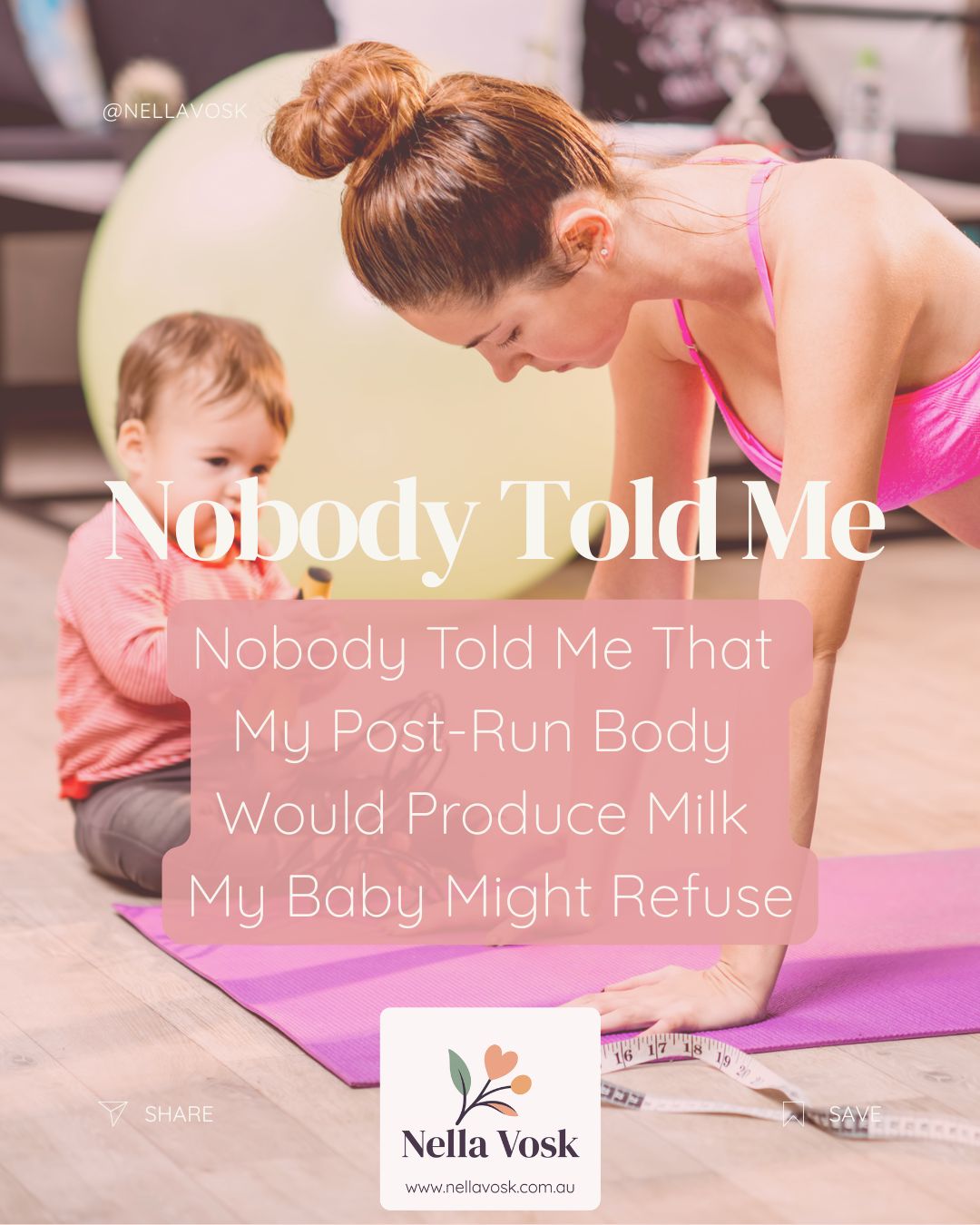
  • Nobody Told Me That My Post-Run Body Would Produce Milk My Baby Might Refuse

    Founder of Nella Vosk • 14+ years supporting families across motherhood, feeding, and early childhood wellbeing

    Nobody Told Me That My Post-Run Body Would Produce Milk My Baby Might Refuse


    This article is part of the Nella Vosk Breastfeeding Nutrition & Milk Supply: Evidence-Based Guide for Australian Mothers — your comprehensive resource on nourishing yourself and your baby through every stage of the feeding journey.

    This article is part of Nella Vosk’s Nobody Told Me series — a growing collection of posts about the information gap that too many mothers encounter after birth. Every article in this series starts from a moment a mother wasn’t told something she needed to know, and works back through the clinical truth behind it. You can find the full series at nellavosk.com.au/pages/nobody-told-me.


    Nobody told me that my post-run body would produce milk my baby might refuse.

    I had been cleared to return to exercise at six weeks and I was ready. The run felt like reclaiming something. I came home flushed and grateful, fed the baby, and she pulled off the breast, screwed up her face, and refused to latch again for the rest of the afternoon.

    I had no idea what had happened. Had my supply dropped? Had something changed in the milk? Was it my fault for running? Nobody — not the obstetrician who cleared me, not the midwife, not the maternal and child health nurse — had mentioned that breast milk can taste noticeably different after intense exercise, that lactic acid accumulates in milk after a hard workout in a way that some babies find unpleasant, or that there are simple strategies to manage this if you want to keep running without disrupting feeding.

    This post explains what breast milk normally tastes like, why tasting your breast milk after exercise can reveal a real change, the lactic acid mechanism behind it, how long the effect lasts, whether exercise affects your milk supply, and what the evidence actually says about safe return to exercise while breastfeeding.

    What Does Breast Milk Normally Taste Like?

    Many breastfeeding mothers find themselves tasting breast milk out of curiosity — usually when collecting or transferring expressed milk, or when a baby spits up and there is milk on a finger. It is a reasonable thing to do, and the experience often surprises people who expect breast milk to taste similar to cow’s milk.

    Mature breast milk has a distinctly sweet taste, significantly sweeter than formula or cow’s milk. The sweetness comes from lactose — the primary carbohydrate in breast milk, present at approximately 7% concentration, higher than the lactose content of cow’s milk. The flavour is mild rather than rich, and the fat content gives it a slightly creamy quality without the pronounced fat flavour of full-fat cow’s milk.

    Breast milk is not a fixed flavour. It changes across the stages of lactation (colostrum has a different taste and colour to mature milk), across the day (night milk has a different hormonal composition to day milk), within a single feed (foremilk is more watery and less sweet than the fattier hindmilk), and in response to maternal diet and physiology. A mother who eats garlic, curry, or other strongly flavoured foods may notice a temporary flavour shift in her milk. A mother who has just finished a hard run may notice something quite different.

    Does Breast Milk Taste Different After Exercise?

    Yes — and the research is clear on the mechanism.

    During moderate to intense exercise, muscles produce lactic acid as a byproduct of anaerobic energy metabolism. Lactic acid (more precisely, lactate, its ionised form) is released from muscle tissue into the bloodstream, where it circulates until it is cleared by the liver and other metabolically active tissues. This clearance is rapid for light to moderate exercise intensities; for high-intensity exercise, peak lactic acid accumulation in the blood can occur within minutes of maximal effort and may take 30 to 60 minutes to return to baseline.

    Lactic acid from the blood passes into breast milk. Research published in Pediatrics and subsequently replicated in several lactation studies has documented that breast milk lactic acid concentration is significantly elevated immediately after maximal or near-maximal exercise, and remains elevated for 30 to 60 minutes post-exercise before returning to pre-exercise levels.

    At elevated concentrations, lactic acid in breast milk produces a noticeably more sour or acidic taste compared to the milk’s normal sweet profile. Research has found that infants may respond differently to this lactic acid-elevated milk: some accept it without apparent awareness of any difference, while others — particularly babies who are young or who are sensitive to flavour variation — may fuss, pull off the breast, or refuse to feed.

    What the Research Actually Shows About Exercise and Breast Milk Taste

    The original research in this area came from a 1992 study by Wallace et al., published in Pediatrics, which found that breast milk collected immediately after maximal exercise had higher lactic acid concentrations and was rejected significantly more often by infants than milk collected before exercise. This study used maximal exertion (exhaustive exercise to maximum effort) and collected milk immediately afterwards.

    Subsequent research has refined this picture considerably:

    • The lactic acid effect is intensity-dependent. Milk collected after moderate-intensity exercise (exercise at 50 to 70% of maximum heart rate, corresponding to a comfortable conversation pace) shows no significant increase in lactic acid concentration. The effect is specific to high-intensity exercise — anything that leaves you breathless, unable to hold a conversation, or at a perceived exertion level of 8 or 9 out of 10.

    • The effect is time-limited. Milk collected 30 to 60 minutes after high-intensity exercise has returned to near-baseline lactic acid levels in most studies. The window of potential taste change is relatively narrow.

    • Infant rejection is not universal. Not all babies reject post-exercise milk, and the same baby may accept it on some occasions and refuse it on others. Individual infant sensitivity to flavour variation is a significant factor.

    • Expressed milk versus direct breastfeeding may behave differently. There is some evidence that the lactic acid concentration in milk expressed by pump immediately post-exercise may be higher than in milk transferred during direct breastfeeding, potentially because the mechanical pressure of pumping extracts milk from throughout the breast including milk that may have been in contact with blood for longer.

    How Long Does the Breast Milk Taste Change Last After Exercise?

    Based on the available research, the post-exercise lactic acid elevation in breast milk is a temporary effect that resolves within 30 to 90 minutes of finishing intense exercise in most women. By one hour post-exercise, breast milk lactic acid levels have typically returned to or near baseline in women who exercised at maximal intensity.

    For moderate-intensity exercise — which covers most common postpartum exercise including brisk walking, light jogging, yoga, pilates, and resistance training at moderate effort — there is no significant lactic acid accumulation in breast milk and no effect on milk taste or infant acceptance has been demonstrated in the research.

    The practical implication is straightforward: if you want to exercise and breastfeed without risk of feeding disruption, the choice is either to keep exercise intensity moderate, or to time high-intensity exercise so that feeding occurs either before the workout or more than an hour after it finishes.

    Does Exercise Affect Milk Supply?

    This is the other question most breastfeeding mothers have about exercise, and the evidence is reassuring.

    Moderate exercise does not reduce milk supply. Multiple studies examining the effect of regular moderate-intensity exercise on milk volume and composition in breastfeeding mothers have found no significant reduction in supply. A mother who walks, jogs at a comfortable pace, swims, cycles, or does yoga and strength training at moderate intensity while breastfeeding does not risk her milk supply.

    The considerations that do matter for supply in the exercise context are:

    Caloric intake

    The caloric demands of breastfeeding are already significant — approximately 450 to 500 extra calories per day above pre-pregnancy maintenance to sustain milk production. Adding exercise to this increases caloric demand further. A breastfeeding mother who is also exercising regularly needs to eat enough to cover both demands. Undereating in the context of both breastfeeding and exercise is one of the most reliable ways to undermine supply. If you are exercising and notice supply changes, the first question to ask is whether you are eating enough to cover your combined metabolic needs. The Nobody Told Me article on breastfeeding hunger and caloric needs covers this in detail.

    Hydration

    Exercise increases fluid loss through sweat, which adds to the already-elevated hydration demands of breastfeeding. Dehydration can temporarily reduce milk output. Drinking adequate water before, during, and after exercise is important for both performance and supply maintenance. The guide to signs of dehydration while breastfeeding covers what adequate hydration actually looks like during breastfeeding.

    High-intensity exercise sustained over time

    There is some evidence that sustained very high-intensity training loads — marathon training, competitive CrossFit, intensive endurance sports at training volumes comparable to competitive athletes — may reduce milk supply in some mothers, potentially through the mechanism of sustained cortisol elevation from training stress or through caloric and nutritional depletion. This is a different scenario from the recreational exercise that most postpartum mothers are returning to, and the evidence is not conclusive. For recreational postpartum exercise at moderate to high intensity, supply effects are unlikely when caloric and hydration needs are met.

    What Breastfeeding Mothers Need to Know About Returning to Exercise

    Start low and progress slowly

    The postpartum body is recovering from birth regardless of fitness level before pregnancy. Ligament laxity (from the pregnancy hormone relaxin), pelvic floor changes, abdominal muscle separation (diastasis recti), and the sleep deprivation of new parenthood all affect exercise capacity and injury risk. Beginning with gentle walking and progressively increasing intensity based on how your body responds is the evidence-based approach, regardless of your pre-pregnancy fitness level.

    Pelvic floor assessment before high-impact exercise

    High-impact exercise — running, jumping, skipping, high-intensity interval training — places significant load on the pelvic floor. Women who had a vaginal birth, a significant perineal tear, or who experience any leakage (urine, wind, or stool) during or after exercise should see a pelvic floor physiotherapist before returning to high-impact activity. Leakage during exercise is common but it is not normal, and it is addressable with appropriate rehabilitation.

    Wear the right support

    Breastfeeding breasts are heavier and more sensitive than pre-pregnancy. A well-fitted, supportive sports bra is important for comfort during exercise. Some mothers find that feeding or expressing before exercise reduces breast fullness and discomfort during the session.

    Feed before you run

    Feeding your baby immediately before exercise means the baby has been recently fed and is less likely to need feeding in the first hour post-exercise (when lactic acid elevation may occur after intense workouts). It also reduces breast fullness during the session, which improves comfort. This is the simplest practical strategy for mothers who want to do high-intensity exercise without feeding disruption.

    Wait an hour if you work out hard

    If you have done high-intensity exercise and want to be confident the lactic acid effect has cleared before feeding, waiting 60 minutes post-workout before offering the breast is a reasonable approach. During this window, you can shower, hydrate, and eat — all of which support your recovery and your supply.

    The Nutritional Picture for Exercising Breastfeeding Mothers

    A breastfeeding mother who is also exercising has the highest combined caloric and nutritional demand of any physiological state that does not involve critical illness. Both breastfeeding and exercise draw on the same pool of nutrients, and inadequacy shows up in both domains: in supply, in recovery, in energy, in mood, and in the slow accumulation of depletion that many active postpartum mothers normalise as “being tired from exercise.”

    Key priorities for the exercising breastfeeding mother:

    • Protein: exercise increases protein requirements for muscle repair and recovery, on top of the already-elevated protein needs of breastfeeding. Aim for consistent protein at every meal — minimum 1.5 to 2g per kilogram of body weight per day is a commonly used clinical target for lactating mothers who are exercising regularly

    • Iron: both exercise (through haemolysis — the mechanical breakdown of red blood cells during high-impact activity) and breastfeeding deplete iron. Active mothers who are breastfeeding have an elevated iron requirement and should request a ferritin check from their GP if they experience unusual fatigue, poor recovery between sessions, or persistent breathlessness during moderate exercise

    • Magnesium: involved in muscle function, energy production, and stress regulation — depleted by both exercise (sweat losses) and breastfeeding. Dark leafy greens, pumpkin seeds, almonds, and dark chocolate are reliable food sources

    • Calories: the combined caloric demand of breastfeeding and exercise is significant and easy to underestimate. A breastfeeding mother running 30 to 40 kilometres per week may need an additional 600 to 1,000 calories above her pre-pregnancy non-exercising baseline — a level that is difficult to achieve consistently without deliberate attention to nutrition

    The guide to best postpartum snacks for energy and milk supply is particularly relevant for active breastfeeding mothers who need accessible, nutrient-dense refuelling options that work around both feeding schedules and exercise recovery.

    Keep Reading

    These posts connect to the exercise and breastfeeding picture:

    Nobody Told Me That Breastfeeding Hunger Is Different to Normal Hunger

    Signs of Dehydration While Breastfeeding (And What to Do)

    10 Proven Ways to Increase Your Milk Supply

    Best Postpartum Snacks for Energy and Milk Supply

    From Colostrum to Mature Milk: The Stages of Breastmilk Production

    Postpartum Nutrition & Recovery: Complete Guide for New Mothers

    Breastfeeding Nutrition & Milk Supply: Evidence-Based Guide


    An active breastfeeding mother has higher nutritional demands than almost any other physiological context. The Nella Vosk lactation range is formulated by a Certified Postpartum Nutrition Professional to support both breastfeeding and the energy demands of an active recovery — because the mother who moves deserves nutrition that moves with her.


    ABOUT THE AUTHOR

    Kelly Northey is a Certified Postpartum Nutrition Professional (CPPNP) and founder of Nella Vosk, an Australian maternal and family wellness brand. She specialises in breastfeeding nutrition, postpartum recovery, and the evidence behind maternal physiology that is rarely explained to new mothers. Learn more about Kelly.


    Also in Nobody Told Me: Breastfeeding & Milk Supply

    Nobody Told Me That Despite Everything Breastmilk Does, It Doesn’t Do Vitamin D
    Nobody Told Me That Despite Everything Breastmilk Does, It Doesn’t Do Vitamin D

    Read More
    Nobody Told Me That How My Birth Went Could Show Up in My Milk
    Nobody Told Me That How My Birth Went Could Show Up in My Milk

    Read More
    Nobody Told Me That My Body Would Notice the Shift Back to Work Before I Even Got There
    Nobody Told Me That My Body Would Notice the Shift Back to Work Before I Even Got There

    Read More