

• Add description, images, menus and links to your mega menu

  • A column with no settings can be used as a spacer

  • Link to your collections, sales and even external links

  • Add up to five columns

  • da

  • A column with no settings can be used as a spacer

  • Link to your collections, sales and even external links

  • Add up to five columns

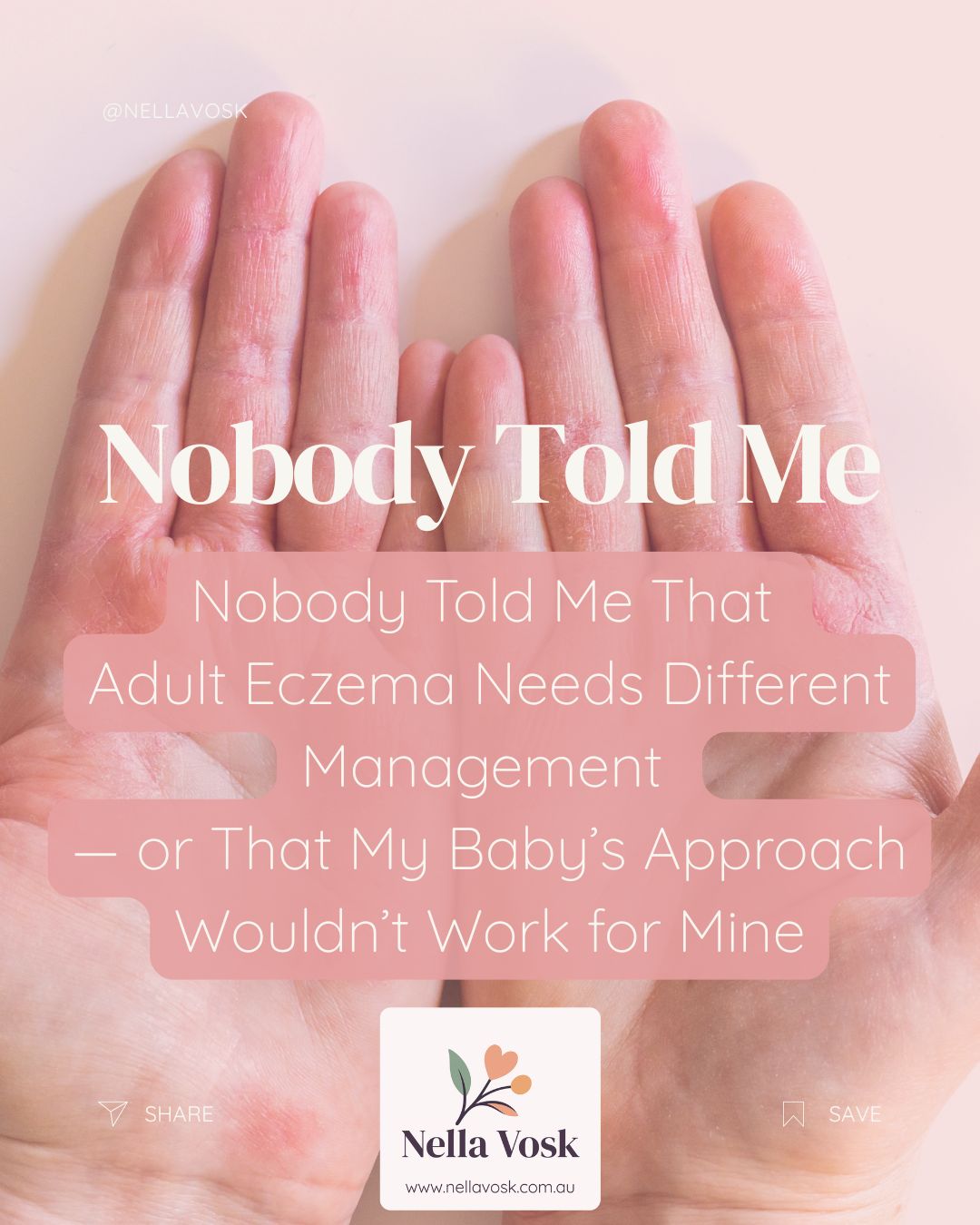
  • Nobody Told Me That Adult Eczema Needs Different Management — or That My Baby’s Approach Wouldn’t Work for Mine

    Founder of Nella Vosk • 14+ years supporting families across motherhood, feeding, and early childhood wellbeing

    Nobody Told Me That Adult Eczema Needs Different Management — or That My Baby’s Approach Wouldn’t Work for Mine

    This article is part of the Nella Vosk Complete Guide to Baby Eczema for Australian Families — everything parents managing atopic dermatitis need to know about triggers, management, and the skin barrier.

    This article is part of Nella Vosk’s Nobody Told Me series — a growing collection of posts written for the parent who has been trying everything and still feels like they’re failing their child. Every post in this series starts from a moment a parent wasn’t given information they needed, and works back through what the evidence actually says. You can find the full series at nellavosk.com.au/pages/nobody-told-me.


    Nobody told me that managing my own eczema was a different problem from managing my baby’s — or that the same approach wouldn’t work for both of us.

    When my son was diagnosed with atopic dermatitis, I became a reluctant expert. I read everything. I learned about the skin barrier, about emollients, about topical steroid ladder protocols, about the triggers that set off his skin and the interventions that helped it settle. I became quite good at managing his eczema.

    What I didn’t realise until considerably later was that during the same period, my own eczema had quietly returned — and I was managing it with the same framework I’d built for an infant. The same emollients. The same steroid potency assumptions. The same approach to flare triggers. And it wasn’t working particularly well.

    Adult eczema is the same underlying condition — atopic dermatitis, a genetic predisposition toward skin barrier dysfunction and immune dysregulation — but it presents differently, is triggered differently, and requires management that accounts for the specific ways eczema behaves in an adult body and adult life. Nobody told me that distinction, and figuring it out late cost me years of suboptimal control.

    How Adult Eczema Presents Differently

    In infants and young children, eczema tends to appear on the face, scalp, and outer surfaces of the arms and legs — the areas most exposed to friction and environmental contact. As children grow, it typically migrates to the flexural creases: behind the knees, inside the elbows, around the wrists and ankles.

    In adults, the distribution often shifts again. Hand eczema is extremely common — and frequently occupational, driven by repeated exposure to water, cleaning products, latex, or other contact irritants in the workplace. Eyelid eczema becomes more prevalent, often triggered by cosmetic products or airborne allergens. Eczema of the neck and décolletage, the scalp, and the face tends to be more common in adults than in children. And chronic, lichenified patches — areas of thickened, leathery skin from years of the itch-scratch cycle — are more characteristically an adult presentation.

    The visible signs also look different. Adult eczema is less often the weeping, crusting presentation common in infants, and more often the dry, thickened, chronically inflamed pattern that develops over years of repeated flares in the same locations.

    What Causes Adult Eczema Flare Ups

    The trigger landscape is meaningfully different in adults compared to children, which is one reason that a management approach calibrated for an infant may not translate well.

    Contact allergens: This is the category most distinctive to adult eczema. Where infant eczema is more commonly driven by food allergens, airborne allergens (dust mites, pollen), and environmental irritants, adult eczema flares are frequently driven by contact with specific substances that directly touch the skin. Fragrance and preservatives in skincare products are the most common contact allergens in adults with eczema. Nickel in jewellery, rubber and latex, preservatives in wet wipes and personal care products, and certain hair care ingredients are also common. Contact allergen identification often requires patch testing with a dermatologist — a specific procedure distinct from the standard allergy skin prick test, and one that is rarely ordered without a specialist referral.

    Occupational exposures: Adults who work with repeated water exposure (healthcare workers, hairdressers, cleaners, food industry workers), chemical agents, or biological materials have significantly elevated rates of hand and forearm eczema. The occupational dimension of adult eczema is substantial and is almost entirely absent from the management picture for childhood eczema. If your eczema consistently worsens during work periods and improves on holidays, occupational exposure is likely a driver.

    Stress: The bidirectional relationship between psychological stress and eczema is more pronounced in adult life than in childhood, because the stress load is different. We covered the stress-eczema loop in detail in an earlier post in this series. For adults, work stress, relationship stress, financial stress, and the exhaustion of managing a child with eczema while also managing their own skin condition form a compounding trigger picture that requires active attention alongside the physical management.

    Skincare and cosmetic products: Adults use a far wider range of skincare, haircare, and cosmetic products than children do — and the fragrance and preservative load in most adult product ranges is substantial. A product that has been tolerated for years can become a trigger after a period of elevated baseline inflammation. Conducting a careful audit of everything applied to the face, neck, hands, and body is a useful early step when adult eczema is worsening without obvious cause.

    Hormonal fluctuations: Many women with atopic dermatitis notice that eczema worsens at specific points in the menstrual cycle, during pregnancy, or during perimenopause. The relationship between oestrogen, progesterone, and skin barrier function is well-documented. This is not a reason to accept eczema as unmanageable during these periods — it is a reason to anticipate flares and apply preventive strategies during known high-risk windows.

    The Lichenification Problem

    One of the most significant differences in adult eczema management is the presence of lichenification — the thickening, hardening, and darkening of skin that develops after prolonged repeated scratching in the same area. Lichenified skin is more resistant to topical treatments than acutely inflamed skin, requires longer treatment courses, and is more likely to need higher-potency corticosteroids or alternative agents like topical calcineurin inhibitors (tacrolimus, pimecrolimus) to resolve.

    Adults who have had eczema since childhood often have established lichenified patches that have been inadequately treated for years — because nobody identified them as a specific management challenge requiring a different approach from acute flare management. If you have patches of skin that are chronically thickened, persistently darker than surrounding skin, and don’t fully resolve even when the acute itch settles, this is worth raising explicitly at a GP or dermatologist appointment as a distinct management question.

    Managing Adult Eczema: Where the Approach Differs

    Emollient choice: Adults generally require thicker, more occlusive emollients than infants — particularly for hand and body eczema. Ointments (paraffin-based preparations, petroleum jelly) provide greater barrier occlusion than creams or lotions and are more effective for chronically dry, thickened adult skin. The instinct to reach for a lighter lotion because it feels less greasy typically works against the skin barrier in moderate to severe adult eczema.

    Topical steroid potency: Adult skin can tolerate and often requires higher-potency topical corticosteroids than infant skin — particularly on the body, hands, and feet. The standard caution around topical steroid use in infants does not apply in the same way to adult skin. Under-treatment with low-potency steroids on lichenified adult skin is common and is a reason flares don’t fully resolve. A GP or dermatologist familiar with adult eczema is the right resource for potency guidance.

    Frequency and consistency: The twice-daily emollient routine that is standard for infant eczema management is equally important for adults — but harder to maintain in an adult life with work, childcare, and competing demands. The research is consistent that emollient application frequency is one of the strongest predictors of eczema control. Building the routine into existing anchors in the day — directly after showering, before bed — rather than treating it as an additional task is a practical way to maintain consistency.

    Nighttime management: The same principles that apply to a child’s eczema at night apply to an adult’s. Emollient applied to slightly damp skin immediately after showering, breathable sleepwear in natural fibres, and a cool bedroom environment reduce overnight itch and scratching. For adults with significant hand or arm eczema, wearing cotton or bamboo gloves over emollient overnight is a standard clinical recommendation that many adults have never been given.

    The Bamboo Bubby range extends into adult sizing precisely because the parents managing their children’s eczema were also managing their own. Adult eczema sleepwear in the same bamboo-blend fabric covers the same management needs — temperature regulation, friction reduction, scratch protection for restless nights — in garments sized and cut for adult bodies.

    The Psychological Dimension

    Adult eczema carries a psychological burden that is underacknowledged and undersupported. A chronic, visible skin condition affects confidence, social engagement, workplace comfort, and intimate relationships. Many adults with eczema describe the visible nature of the condition — particularly on the hands, face, and neck — as a source of ongoing anxiety and self-consciousness that is separate from and compounding the physical discomfort.

    The stress-eczema relationship we covered in NTM-2-10 runs in both directions: eczema causes stress, and stress worsens eczema. For adults managing a moderate to severe condition, this bidirectional loop can become genuinely debilitating. Psychological support — whether through a GP referral to a psychologist experienced with chronic skin conditions, a structured stress management approach, or peer connection with other adults managing eczema — is a legitimate part of the management picture, not a supplementary afterthought.

    If You’re Rediscovering Your Own Eczema While Managing Your Child’s

    This is one of the most common patterns I see. A parent immerses themselves in understanding their child’s eczema and in the process notices that their own skin — perhaps managed inadequately for years, or returned after a period of remission triggered by the stress and sleep disruption of early parenthood — needs attention too.

    The knowledge you’ve built managing your child’s eczema is directly applicable, with the differences above layered on top. The staging system applies. The trigger identification framework applies. The commitment to consistent emollient use applies. What needs adjusting is the specific product choices, the steroid potency, the attention to contact allergens that are more relevant to adult life, and the acknowledgement that your own skin health matters and deserves the same level of careful attention you’ve given your child’s.

    Related Reading

    Nobody Told Me There Was a Staging System

    Nobody Told Me My Anxiety About the Eczema Might Actually Be Making It Worse

    Eczema-Friendly Clothing Guide

    Best Laundry Detergents for Eczema

    Why Kids Scratch More at Night: The Physiology Explained


    ABOUT THE AUTHOR
    Kelly Northey is a Certified Postpartum Nutrition Professional (CPPNP) and founder of Nella Vosk, the parent company of the Bamboo Bubby range. She has spent fourteen years working with Australian families navigating baby and child eczema — the sleepless nights, the skin that won’t heal, and the guilt of feeling like you should be doing more. The Bamboo Bubby range exists because of those families.
    Learn more about Kelly.


    Also in Nobody Told Me: Your Baby's Skin

    Nobody Told Me I Had to Fight That Hard Just to See a Dermatologist
    Nobody Told Me I Had to Fight That Hard Just to See a Dermatologist

    Read More
    Nobody Told Me That the Antibiotics for the Infected Eczema Might Make the Next Infection More Likely
    Nobody Told Me That the Antibiotics for the Infected Eczema Might Make the Next Infection More Likely

    Read More
    Nobody Told Me the Behaviour Issues Might Be the Eczema, Not My Parenting
    Nobody Told Me the Behaviour Issues Might Be the Eczema, Not My Parenting

    Read More