


• Add description, images, menus and links to your mega menu

  • A column with no settings can be used as a spacer

  • Link to your collections, sales and even external links

  • Add up to five columns

  • da

  • A column with no settings can be used as a spacer

  • Link to your collections, sales and even external links

  • Add up to five columns

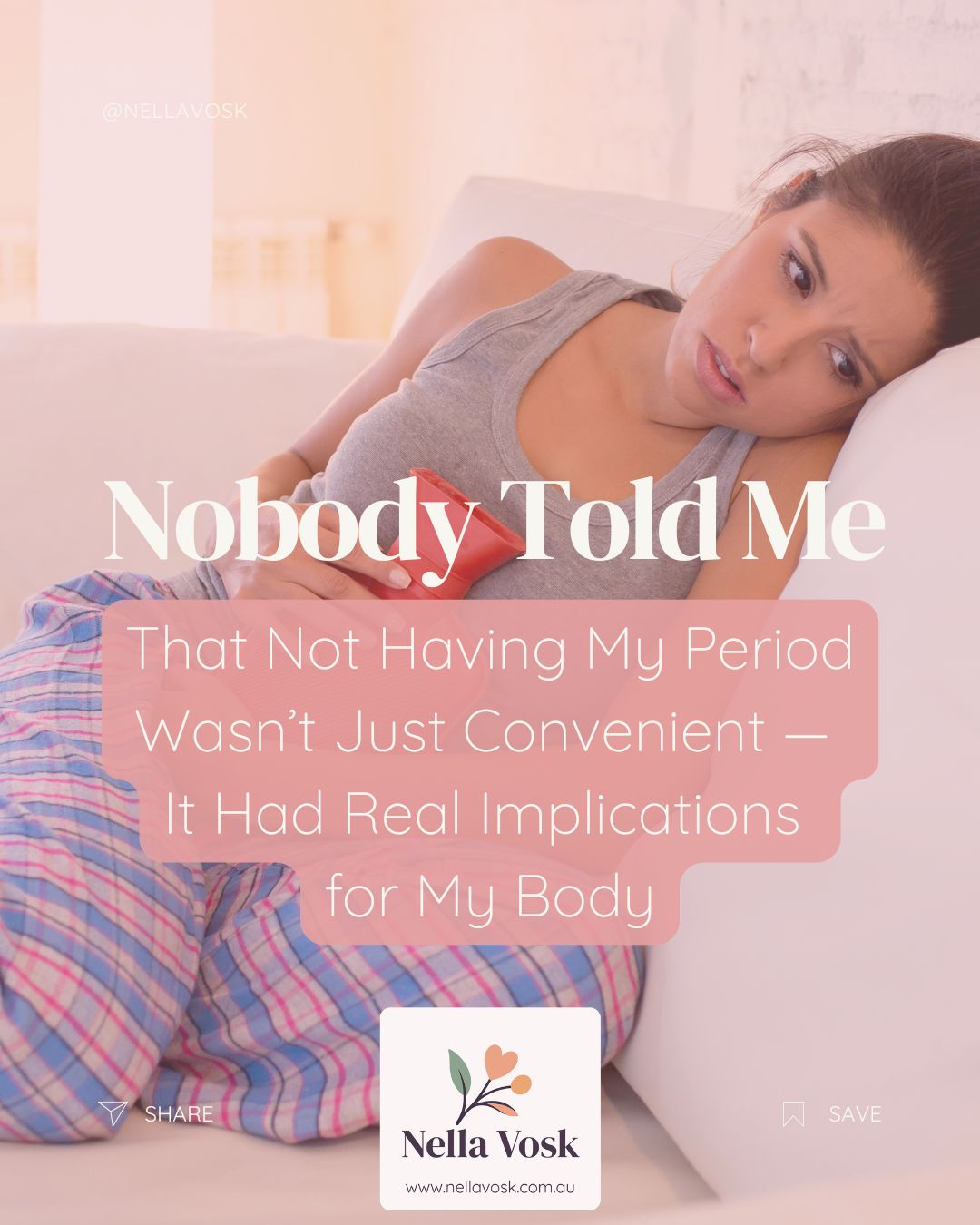
  • Nobody Told Me That Not Having My Period Wasn’t Just Convenient — It Had Real Implications for My Body

    Founder of Nella Vosk • 14+ years supporting families across motherhood, feeding, and early childhood wellbeing

    Nobody Told Me That Not Having My Period Wasn’t Just Convenient — It Had Real Implications for My Body


    This article is part of the Nella Vosk Postpartum Nutrition & Recovery: Complete Guide for New Mothers — your comprehensive resource on rebuilding your body after birth.

    This article is part of Nella Vosk’s Nobody Told Me series — a growing collection of posts about the information gap that too many mothers encounter after birth. Every article in this series starts from a moment a mother wasn’t told something she needed to know, and works back through the clinical truth behind it. You can find the full series at nellavosk.com.au/pages/nobody-told-me.


    Nobody told me that not having my period while breastfeeding wasn’t just convenient. That it was a hormonally active state with real implications for my bone health, my fertility, my joint health, and my mood. That the same prolactin that was keeping my period away was also suppressing oestrogen in ways that had measurable physiological consequences beyond the welcome absence of a monthly cycle.

    I was grateful for the reprieve. Most breastfeeding mothers are. But gratitude and information are different things, and the information I was never given — about what lactational amenorrhea actually is, what it means for the body, and what the signs of period return while breastfeeding actually signal — would have helped me understand what my body was doing during one of the most hormonally significant periods of my life.

    This post covers what lactational amenorrhea is, how the hormonal mechanism works, what the signs of your period returning while breastfeeding look like, when to expect the return, what the bone density and joint implications are, how reliable the lactational amenorrhea method (LAM) is as contraception, and what to do nutritionally to support your body through this hormonal state.

    What Lactational Amenorrhea Is

    Lactational amenorrhea is the medical term for the suppression of menstruation that occurs during breastfeeding. It is not a side effect or a complication — it is a physiological feature of the breastfeeding state, operating through a well-characterised hormonal mechanism that has been understood in increasing detail over the past two decades.

    Amenorrhea means the absence of menstruation. Lactational amenorrhea means the absence of menstruation caused by lactation. During exclusive or near-exclusive breastfeeding, the hormonal environment of the breastfeeding state suppresses the ovarian cycle, preventing ovulation and therefore preventing menstruation.

    The average duration of lactational amenorrhea varies considerably between women and between populations, but research suggests that in mothers who are exclusively breastfeeding and feeding on demand, the average return of menstruation occurs at around 6 to 8 months postpartum in Western populations. Many mothers do not see their period return until they reduce breastfeeding frequency, introduce supplementary feeds, or wean entirely. A small number of breastfeeding mothers see their period return within the first few months despite exclusive breastfeeding.

    How the Hormonal Mechanism Works

    Understanding why breastfeeding suppresses menstruation requires a brief look at the hormonal pathway involved — which is more interesting than most popular explanations suggest.

    Breastfeeding maintains elevated prolactin levels, particularly in the periods immediately following a feed and during the night, when prolactin peaks are highest. This elevated prolactin state has a cascading effect on the hormonal systems that govern the menstrual cycle:

    • High prolactin suppresses kisspeptin neurons in the hypothalamus. Kisspeptin is a key signalling peptide that drives the pulsatile release of gonadotropin-releasing hormone (GnRH) — the upstream hormone that controls the entire reproductive hormonal cascade.

    • Suppressed GnRH release leads to decreased pulsatile secretion of LH (luteinising hormone). It is the pre-ovulatory LH surge that triggers ovulation; without adequate LH pulsatility, ovulation cannot occur.

    • Without ovulation, no follicular maturation occurs, progesterone and oestrogen do not cycle in the normal pattern, and menstruation does not follow.

    This is a neat, functionally integrated system: the suckling stimulus maintains prolactin, prolactin suppresses kisspeptin, kisspeptin suppression disrupts GnRH, and the absence of normal GnRH pulsatility prevents ovulation. The frequency and intensity of breastfeeding is directly coupled to the effectiveness of this suppression. When feeding frequency decreases — as it does when supplementary feeds are introduced, when the baby begins sleeping longer overnight, or when the baby begins to self-regulate with complementary foods — prolactin levels fall, kisspeptin suppression lifts, GnRH pulsatility resumes, and ovulation — and eventually menstruation — returns.

    Signs of Period Returning While Breastfeeding

    Many mothers notice a cluster of physical changes in the days or weeks before their period returns while breastfeeding. These signs reflect the shift in the hormonal environment as oestrogen and progesterone begin to cycle again:

    Breast and nipple sensitivity changes

    One of the most commonly reported signs of period returning while breastfeeding is a change in nipple or breast sensitivity around feeds — a return of tenderness, discomfort, or a different quality of feeding sensation that was not present during the amenorrhoeic months. This reflects the oestrogen and progesterone fluctuations of an emerging cycle affecting breast tissue sensitivity.

    Changes in milk supply or baby’s feeding behaviour

    Around ovulation and in the premenstrual phase, some breastfeeding mothers notice a temporary dip in milk supply or a change in milk composition — a very mild transient drop in milk sodium levels has been documented in the peri-menstrual phase in some women. Babies sometimes respond to these subtle changes by being more unsettled at the breast or feeding more frequently for a day or two. Many mothers report this as the first signal that something hormonal is shifting.

    Breastfeeding aversion

    As noted in the earlier NTM post on magnesium, breastfeeding aversion — the uncomfortable, skin-crawling sensation during a feed — is associated with hormonal fluctuations and is reported more commonly in the premenstrual phase and around ovulation in cycling breastfeeding mothers. If breastfeeding aversion appears or intensifies at what turns out to be a predictable point in the month, it may be signalling the return of the cycle before the first bleed appears.

    Premenstrual symptoms returning

    Mood changes, bloating, lower abdominal cramping, breast tenderness, and the other premenstrual symptoms a mother experienced before pregnancy may return in the days before her first postpartum period, even if she is not yet expecting it. These symptoms reflect the re-emergence of the luteal phase hormonal pattern.

    Ovulation pain

    Some women experience mittelschmerz — a mild one-sided pain at ovulation — and this may return in the weeks or months before the first period, as ovulation resumes before a full menstrual cycle is established. The first return of ovulation typically precedes the first return of menstruation by approximately two weeks.

    The first period itself

    The first postpartum period is often heavier than pre-pregnancy periods, more crampy, or of different duration. This is normal and reflects the uterine lining that has been quiescent during lactational amenorrhea building up for longer than a usual cycle. Most mothers find subsequent cycles normalise within two to three months of the first period.

    When Does Period Return After Birth While Breastfeeding?

    There is no single answer to when the period returns while breastfeeding, because the timing is directly governed by feeding frequency and intensity — both of which vary enormously between mothers and babies. The research shows a wide range:

    • Exclusive, on-demand breastfeeding with no supplementary feeds and night feeds maintained: average return at 6 to 8 months, but with significant individual variation ranging from 2 to 18 months or more

    • Partial breastfeeding or introduction of supplementary feeds: period typically returns sooner as prolactin levels fall with reduced feeding frequency

    • Formula supplementation introduced: period often returns within 1 to 3 months of significant formula supplementation beginning

    • Night weaning or longer overnight sleep intervals: prolactin is highest overnight; reducing night feeds often triggers an earlier return of menstruation

    • Complete weaning: period typically returns within 4 to 6 weeks of fully stopping breastfeeding in most women, though individual variation is significant

    If your period has not returned by 12 months postpartum and you have reduced or stopped breastfeeding, it is worth discussing with your GP — while this is often simply a slower individual hormonal reset, other causes of secondary amenorrhea (thyroid dysfunction, hypothalamic amenorrhea from undereating or overexercising, PCOS) are worth ruling out.

    Can You Still Get Pregnant While Breastfeeding?

    Yes — and this is one of the most important things many breastfeeding mothers are not told clearly enough.

    Ovulation typically precedes the first period return by approximately two weeks. This means that a mother can ovulate — and therefore can conceive — before she has had her first postpartum period. A mother who believes she is not at risk of pregnancy because she has not yet had a period may be wrong if her breastfeeding frequency has begun to decrease.

    The Lactational Amenorrhea Method (LAM) is a recognised form of natural contraception, but it has specific conditions that must all be met for it to be reliably effective:

    • The baby must be less than 6 months old

    • The mother must be fully or near-fully breastfeeding, with no long gaps between feeds (no more than 4 to 6 hours between feeds during the day and no more than 6 hours at night)

    • The mother must have had no return of menstruation since giving birth

    When all three conditions are met, LAM has an effectiveness rate of approximately 98% in the first 6 months, comparable to many hormonal methods. When any one condition is not met — the baby is older than 6 months, a period has returned, or feeding frequency has reduced significantly — LAM is no longer a reliable contraceptive method and an additional method should be used.

    If you are relying on breastfeeding for contraception, discuss the specific conditions of LAM with your GP or maternal and child health nurse. Any change in feeding frequency, introduction of supplementary feeds, or longer overnight sleep intervals changes your contraceptive risk. This is particularly important if another pregnancy in the near term would be difficult or harmful.

    The Bone Density Dimension Nobody Mentions

    Here is the part of the lactational amenorrhea story that is almost never communicated to breastfeeding mothers, and that I believe should be.

    The prolactin-driven suppression of menstruation during breastfeeding operates in a state of relative oestrogen deficiency. Oestrogen is the primary hormone that maintains bone density in premenopausal women, stimulating osteoblast (bone-building) activity and suppressing osteoclast (bone-resorbing) activity. In the oestrogen-deficient state of lactational amenorrhea, bone remodelling is dysregulated: bone resorption is elevated, bone formation is relatively suppressed, and there is a net loss of bone mineral density during exclusive breastfeeding.

    Research consistently shows that breastfeeding mothers lose approximately 3 to 7% of bone mineral density during the first 6 months of exclusive breastfeeding. This is significantly more than the bone loss of pregnancy itself, and it occurs specifically in the trabecular bone of the spine and hip — the sites most relevant to long-term fracture risk.

    The evidence is clear that this bone loss is largely reversible. Bone mineral density typically returns to or near pre-pregnancy levels within 6 to 12 months after weaning, as oestrogen levels recover and normal bone turnover is restored. Multiple studies following mothers for years after weaning find no significant long-term deficit in bone density from a single period of breastfeeding.

    However, there are circumstances in which the picture is less straightforward:

    • Mothers with low calcium intake during breastfeeding may not fully recover bone density after weaning, as the body may have drawn on bone calcium stores beyond what diet alone can restore

    • Mothers who breastfeed multiple children in close succession with short or no intervals between the end of one breastfeeding period and the beginning of the next pregnancy have less time for bone recovery between periods of bone resorption

    • Mothers who also have other risk factors for osteoporosis (low body weight, family history, smoking, low vitamin D) may have less reserve to draw from

    The practical implication is not that breastfeeding is harmful to bone health — the long-term evidence does not support this for typical breastfeeding durations. The implication is that calcium and vitamin D intake during breastfeeding, and between pregnancies, genuinely matters for bone density recovery.

    Joint Pain, Vaginal Dryness, and the Oestrogen Connection

    Two physical experiences during extended breastfeeding that are rarely connected to the hormonal mechanism by the women experiencing them:

    Joint pain and hypermobility

    Oestrogen deficiency during lactational amenorrhea is associated with changes in collagen elasticity and joint laxity. Some breastfeeding mothers experience joint pain, wrist pain (sometimes confused with De Quervain’s tenosynovitis), hip instability, or generalised joint discomfort during extended breastfeeding periods. This is the same mechanism that produces musculoskeletal symptoms in perimenopausal women as oestrogen falls. Adequate vitamin D, calcium, and protein — all key postpartum nutrients — support connective tissue health during this oestrogen-low period.

    Vaginal dryness and discomfort

    Vaginal dryness and discomfort during intimacy is extremely common during breastfeeding and is directly caused by the oestrogen deficiency of lactational amenorrhea. It is often experienced as one of the most distressing postpartum physical changes and is frequently not mentioned at the six-week check unless specifically raised. Local oestrogen treatment or non-hormonal lubricants are appropriate options and should be discussed with a GP; breastfeeding does not preclude treatment.

    Nutritional Support During Lactational Amenorrhea

    The oestrogen-low, bone-resorbing state of lactational amenorrhea has specific nutritional implications:

    Calcium

    The NHMRC recommends 1,000mg of calcium per day for breastfeeding women aged 19 to 50 (the same as the pre-pregnancy recommendation). During lactational amenorrhea, when bone resorption is elevated, consistent calcium intake is important for bone density recovery. Dairy (milk, yoghurt, hard cheese), calcium-set tofu, canned fish with bones (sardines, salmon), and fortified plant milks are the most reliable dietary calcium sources.

    Vitamin D

    Vitamin D is required for calcium absorption and bone mineralisation. Despite Australia’s sunshine, vitamin D deficiency is common in postpartum mothers — particularly in southern states, in women with darker skin, and in mothers who spend most of their time indoors. A vitamin D check at or after the six-week check is appropriate and worth requesting. The NHMRC recommends 5 micrograms (200 IU) of vitamin D daily for breastfeeding women, though many practitioners recommend higher doses (1,000 to 2,000 IU) in the context of confirmed deficiency.

    Protein and collagen support

    Adequate protein — from meat, fish, eggs, legumes, and dairy — supports the connective tissue and bone matrix that calcium is laid down into. Protein is also one of the nutrients most likely to be insufficiently consumed by breastfeeding mothers managing new parenthood. Aim for protein at every meal and snack.

    Magnesium

    Magnesium is a cofactor in bone mineralisation and works alongside calcium and vitamin D in bone metabolism. As covered in the previous NTM post on magnesium, it is also commonly depleted during breastfeeding and supports both bone health and the sleep quality that the bone-repairing body needs.

    For the complete nutritional picture of what the postpartum body needs, the article on signs of postpartum depletion covers the full depletion profile including bone-relevant nutrients.

    Does Period Return Affect Milk Supply?

    Many mothers worry that the return of their period while breastfeeding means their supply will drop or that something has changed in their milk. The evidence is reassuring on both counts:

    • Overall milk supply is not significantly affected by the return of menstruation. The supply-and-demand mechanism remains the primary driver of how much milk is produced

    • Some mothers notice a very mild, temporary dip around ovulation or in the premenstrual phase, which resolves when the hormonal fluctuation passes. This is generally modest and does not require supply-building intervention

    • Milk composition changes slightly but insignificantly around the menstrual cycle. The nutritional adequacy of breast milk is maintained

    • If a significant supply drop occurs around the period and persists across multiple cycles, this warrants a review with an IBCLC or GP to rule out other supply-affecting factors

    The return of periods while breastfeeding does not mean breastfeeding is ending or failing. Many mothers continue breastfeeding for months or years after their period returns.

    Keep Reading

    These posts support the postpartum hormonal recovery picture:

    Signs of Postpartum Depletion (And What to Do)

    Postpartum Nutrition & Recovery: Complete Guide for New Mothers

    Nobody Told Me I’d Mourn the End of Breastfeeding

    Iron-Rich Foods for Postpartum Recovery

    Breastfeeding Nutrition & Milk Supply: Evidence-Based Guide

    Best Postpartum Snacks for Energy and Milk Supply

    Postpartum Allergies: Why They Happen & What to Do


    Lactational amenorrhea is a physiological state with real implications for bone health, joint health, and hormonal wellbeing that almost no postnatal care addresses. Nourishing yourself through this hormonal period is not optional — it is foundational. The Nella Vosk postpartum recovery range is formulated by a Certified Postpartum Nutrition Professional to support the specific nutritional needs of the breastfeeding body — including those that the absence of a period quietly creates.


    ABOUT THE AUTHOR

    Kelly Northey is a Certified Postpartum Nutrition Professional (CPPNP) and founder of Nella Vosk, an Australian maternal and family wellness brand. She specialises in postpartum hormonal recovery, breastfeeding nutrition, and the physiological dimensions of motherhood that standard care consistently undercommunicates. Learn more about Kelly.


    Also in Nobody Told Me: Your Body After Birth

    Nobody Told Me That Watching My Hair Fall Out Was Part of the Postpartum Deal — or That Nutrition Could Help
    Nobody Told Me That Watching My Hair Fall Out Was Part of the Postpartum Deal — or That Nutrition Could Help

    Read More
    Nobody Told Me I Could Sleep Better Between Feeds with Something as Simple as Magnesium
    Nobody Told Me I Could Sleep Better Between Feeds with Something as Simple as Magnesium

    Read More
    Nobody Told Me That Pregnancy Had Literally Borrowed from My Brain
    Nobody Told Me That Pregnancy Had Literally Borrowed from My Brain

    Read More