


• Add description, images, menus and links to your mega menu

  • A column with no settings can be used as a spacer

  • Link to your collections, sales and even external links

  • Add up to five columns

  • da

  • A column with no settings can be used as a spacer

  • Link to your collections, sales and even external links

  • Add up to five columns

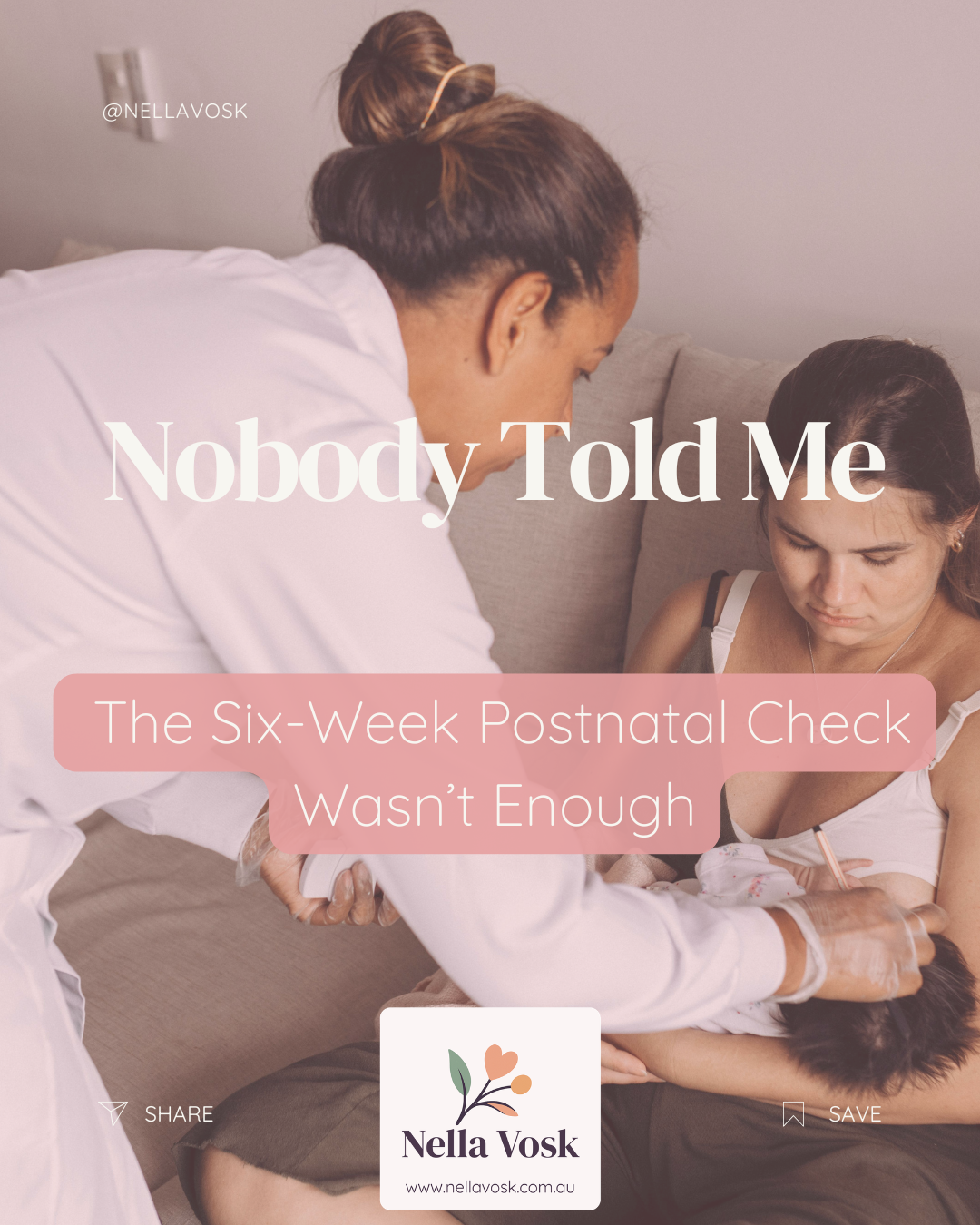
  • Nobody Told Me the Six-Week Postnatal Check Wasn’t Enough

    Founder of Nella Vosk • 14+ years supporting families across motherhood, feeding, and early childhood wellbeing

    Nobody Told Me the Six-Week Postnatal Check Wasn’t Enough


    This article is part of the Nella Vosk Postpartum Nutrition & Recovery: Complete Guide for New Mothers — your comprehensive resource on rebuilding your body after birth.

    This article is part of Nella Vosk’s Nobody Told Me series — a growing collection of posts about the information gap that too many mothers encounter after birth. Every article in this series starts from a moment a mother wasn’t told something she needed to know, and works back through the clinical truth behind it. You can find the full series at nellavosk.com.au/pages/nobody-told-me.

    Nobody told me the six-week postnatal check wasn’t actually checking whether I was OK. I remember sitting in that room thinking I’d been given the all-clear. Nobody asked how I was sleeping beyond a polite “how are you going?” Nobody mentioned that what I was eating might have something to do with how I was feeling. Nobody asked about my energy, my hair, the fog that had settled over everything. The appointment took eleven minutes. I walked out with a referral for pelvic floor physio and a quiet sense that I was supposed to feel better by now.

    I didn’t. And as I’ve learned across 14 years working with postpartum families, I wasn’t alone.

    The six-week postnatal check is one of the most significant missed opportunities in Australian maternal healthcare. Not because GPs don’t care — most do, deeply — but because the structure of that appointment was never designed to catch what postpartum depletion actually looks like. And most mothers walk out of it believing they’ve been cleared when, nutritionally and hormonally, the hardest stretch may still be ahead.

    What the 6 Week Postnatal Check Actually Covers

    The 6 week checkup after birth in Australia is a standard GP appointment, usually between 10 and 20 minutes, focused on a defined list of physical and emotional markers. Your GP will typically:

    • Check that any perineal tear or caesarean wound is healing

    • Assess whether your uterus has returned to pre-pregnancy size

    • Screen for postnatal depression using the Edinburgh Postnatal Depression Scale

    • Discuss contraception

    • Ask broadly about how you’re going and how feeding is progressing

    These are all important. The Edinburgh screen alone has meaningfully improved rates of postnatal depression diagnosis in Australia, and wound checks matter. But look at what’s missing.

    There is no standard nutritional assessment. There is no iron check (unless you specifically request one or had a complicated birth). There is no conversation about postpartum depletion as a physiological reality. There is no ask about the quality of what you’re eating — only whether you’re managing.

    The RACGP itself has noted in its clinical literature that the research does not support any specific benefit of the six-week check in its traditional form, and has called for a more proactive, earlier approach. The check, as currently structured, was designed to confirm physical recovery from birth. It was not designed to address the sustained nutritional demands of the weeks and months that follow.

    What Postpartum Depletion Actually Looks Like at Six Weeks

    Here is what’s happening in a postpartum body at the six-week mark that the standard check doesn’t touch.

    Iron is still recovering

    The average vaginal birth involves 300 to 500ml of blood loss. A caesarean section typically 750 to 1,000ml or more. Every millilitre of blood lost contains iron, and six weeks is not enough time for iron stores to fully replenish from diet alone — particularly in a mother who was already low during pregnancy. Iron deficiency without anaemia (where ferritin is low but haemoglobin hasn’t dropped far enough yet to flag as anaemia) is extremely common at this stage, and causes fatigue, brain fog, low mood, and poor concentration. It is almost never tested at the six-week postnatal check unless you ask.

    DHA levels are significantly depleted

    During pregnancy, the developing baby draws DHA — a long-chain omega-3 fatty acid essential for brain and nervous system development — preferentially from the mother’s stores. Breastfeeding continues this demand. Research suggests Australian mothers are among the most DHA-depleted postpartum in the developed world, partly because our diets are lower in oily fish than many European populations. Low DHA is associated with postnatal depression, persistent brain fog, and impaired cognitive function. It is not on the six-week check list.

    Zinc has been rapidly used up

    Zinc is one of the most rapidly depleted minerals postpartum. It is critical for wound healing, immune function, and mood regulation — and birth, whether vaginal or surgical, places a significant acute demand on zinc reserves. If you experienced a perineal tear, a caesarean section, or significant blood loss, your zinc needs post-birth are particularly elevated. Low zinc can present as slow wound healing, increased susceptibility to infection, low mood, and loss of taste or smell — symptoms that are often attributed to tiredness or stress rather than nutritional insufficiency.

    Iodine is being drawn by breastfeeding

    Australia’s soil is naturally iodine-poor, and our diets reflect this. Breastfeeding places a significant ongoing demand on iodine reserves because breast milk must be actively enriched with iodine for the baby’s thyroid development. A mother who was marginally iodine-sufficient during pregnancy may find herself with depleted iodine by the time she reaches six weeks postpartum — contributing to fatigue, difficulty concentrating, and a sluggish metabolic rate.

    The hormonal landscape is still shifting

    Oestrogen and progesterone, which were at peak levels in late pregnancy, drop rapidly in the days after birth to trigger milk production. At six weeks, most breastfeeding mothers are in a state of relative oestrogen deficiency — a hormonal environment similar in some ways to the perimenopausal period. This contributes to vaginal dryness (relevant when the GP asks if you’ve “resumed intimacy”), joint discomfort, mood instability, and the emotional rawness that many mothers are still feeling at six weeks but are reluctant to describe because they’ve already been asked about depression.

    What the Six-Week Check Gets Right

    It’s worth being fair here. The check is not useless — far from it.

    The postnatal depression screen has changed the trajectory for many women who would otherwise have gone months without a diagnosis or support. GPs who take an extended appointment seriously can cover a great deal of ground. The conversation about contraception matters, because fertility can return surprisingly quickly in mothers who are supplementing feeds or whose supply is reducing. Wound checks have genuine clinical value.

    The problem is not the check itself. The problem is what mothers believe about it afterwards. When a healthcare professional says “you’re looking great, see you in a year,” most mothers interpret this as confirmation that their body has recovered. And that interpretation is understandable — and wrong.

    How Long Postpartum Recovery Actually Takes

    Research on postpartum nutritional recovery consistently shows that iron stores, omega-3 levels, zinc, iodine, and vitamin D can take months — not weeks — to fully replenish from diet alone. In mothers who breastfeed, some of these demands continue for the entire duration of the feeding relationship.

    Postpartum depletion — a state of persistent nutritional and hormonal deficit that underlies much of the fatigue, fog, and emotional fragility that characterises the first year of motherhood — has been documented as lasting two years or more in mothers who do not actively support their recovery through nutrition.

    Two years. Not six weeks.

    The six-week postnatal check marks the end of formal postpartum medical care in Australia. It does not mark the end of the recovery timeline. These are very different things, and conflating them does a quiet but significant harm to the mothers who are doing everything they’ve been told to do and still wondering why they don’t feel like themselves.


    What to Ask at Your 6 Week Postpartum Check Up

    If you have an upcoming 6 week postpartum check up, book a longer appointment — at least 20 minutes if your clinic allows it. Then consider asking for:

    • A full blood count (FBC) and ferritin test, not just haemoglobin. Ferritin is the stored iron measure. Haemoglobin can appear normal while ferritin is dangerously low.

    • A thyroid function test if you’re experiencing significant hair loss, cold sensitivity, weight changes, or persistent low mood. Postpartum thyroiditis affects around 5-10% of women and is frequently missed.

    • A vitamin D check, particularly if you live in a southern state, have darker skin, or spend limited time outdoors.

    • An honest conversation about your energy, not just your mood. Postnatal depression screening matters, but fatigue that isn’t improving with better sleep is a nutritional signal worth investigating separately.

    • A referral to a dietitian or nutritionist with postpartum experience if you feel your recovery nutrition needs more support than a standard appointment can give.

    You are entitled to advocate for this. Most GPs will respond well to a patient who comes in with specific questions. What stops most mothers from asking is the belief that the check has already told them everything they need to know.

    It hasn’t. It’s a starting point, not a finish line.

    What Actually Supports Postpartum Recovery Beyond the Check

    The single most important thing a postpartum mother can do in the weeks and months after her six-week check is eat. Consistently, densely, with attention to the specific nutrients her body has just given to her baby and hasn’t yet replenished.

    This means:

    • Iron-rich foods daily: red meat, lamb, liver (once weekly), eggs, legumes, dark leafy greens, pumpkin seeds. Paired with vitamin C to maximise non-haem iron absorption.

    • Oily fish two to three times per week for DHA: salmon, sardines, mackerel. Lower-mercury options are safest if breastfeeding.

    • Zinc-rich foods: red meat, oysters, pumpkin seeds, legumes, wholegrains.

    • Iodine from seafood, eggs, and dairy — the best available dietary sources given Australian soil iodine levels.

    • Adequate calories. Breastfeeding requires up to 500 additional calories per day above pre-pregnancy maintenance. Eating below this threshold worsens depletion and is associated with supply reduction.

    Warm, easily digestible food is particularly well tolerated in the postpartum period. Nourishing soups and broths, slow-cooked proteins, cooked vegetables rather than raw salads — these are traditional postpartum foods from almost every culture because they are genuinely easier on a digestive system that is still recovering from birth.

    If whole-food nutrition feels out of reach with a newborn — and for many mothers, it genuinely does — targeted postpartum nourishment products can help fill the gaps while you build a more sustainable food rhythm.

    Keep Reading

    For the full picture of what your body needs in the months after birth, these posts go deeper: 

    Signs of Postpartum Depletion (And What to Do)

    Postpartum Bleeding (Lochia): What’s Normal After Birth

    Iron-Rich Foods for Postpartum Recovery

    Best Postpartum Snacks for Energy and Milk Supply

    Postpartum Meal Planning for Busy, Exhausted Mothers

    Best Tea for Postpartum Recovery (What Actually Helps)


    Your body did something extraordinary. The six-week check is a beginning — not a sign-off. If you’re still feeling depleted, foggy, flat, or just not quite yourself, that is a signal worth paying attention to. Explore the Nella Vosk postpartum recovery range — formulated by a Certified Postpartum Nutrition Professional to support the recovery the system doesn’t always explain.


    ABOUT THE AUTHOR

    Kelly Northey is a Certified Postpartum Nutrition Professional (CPPNP) and founder of Nella Vosk, an Australian maternal and family wellness brand.
    She created the Nourish Mama range after her own postpartum experience and 14+ years of working with breastfeeding and postpartum families.
    Kelly writes about postpartum nutrition, breastfeeding support, and the things the conventional system consistently fails to tell mothers.
    Learn more about Kelly.


    Also in Nobody Told Me: Your Body After Birth

    Nobody Told Me That Watching My Hair Fall Out Was Part of the Postpartum Deal — or That Nutrition Could Help
    Nobody Told Me That Watching My Hair Fall Out Was Part of the Postpartum Deal — or That Nutrition Could Help

    Read More
    Nobody Told Me That Not Having My Period Wasn’t Just Convenient — It Had Real Implications for My Body
    Nobody Told Me That Not Having My Period Wasn’t Just Convenient — It Had Real Implications for My Body

    Read More
    Nobody Told Me I Could Sleep Better Between Feeds with Something as Simple as Magnesium
    Nobody Told Me I Could Sleep Better Between Feeds with Something as Simple as Magnesium

    Read More