• Add description, images, menus and links to your mega menu

  • A column with no settings can be used as a spacer

  • Link to your collections, sales and even external links

  • Add up to five columns

  • da

  • A column with no settings can be used as a spacer

  • Link to your collections, sales and even external links

  • Add up to five columns

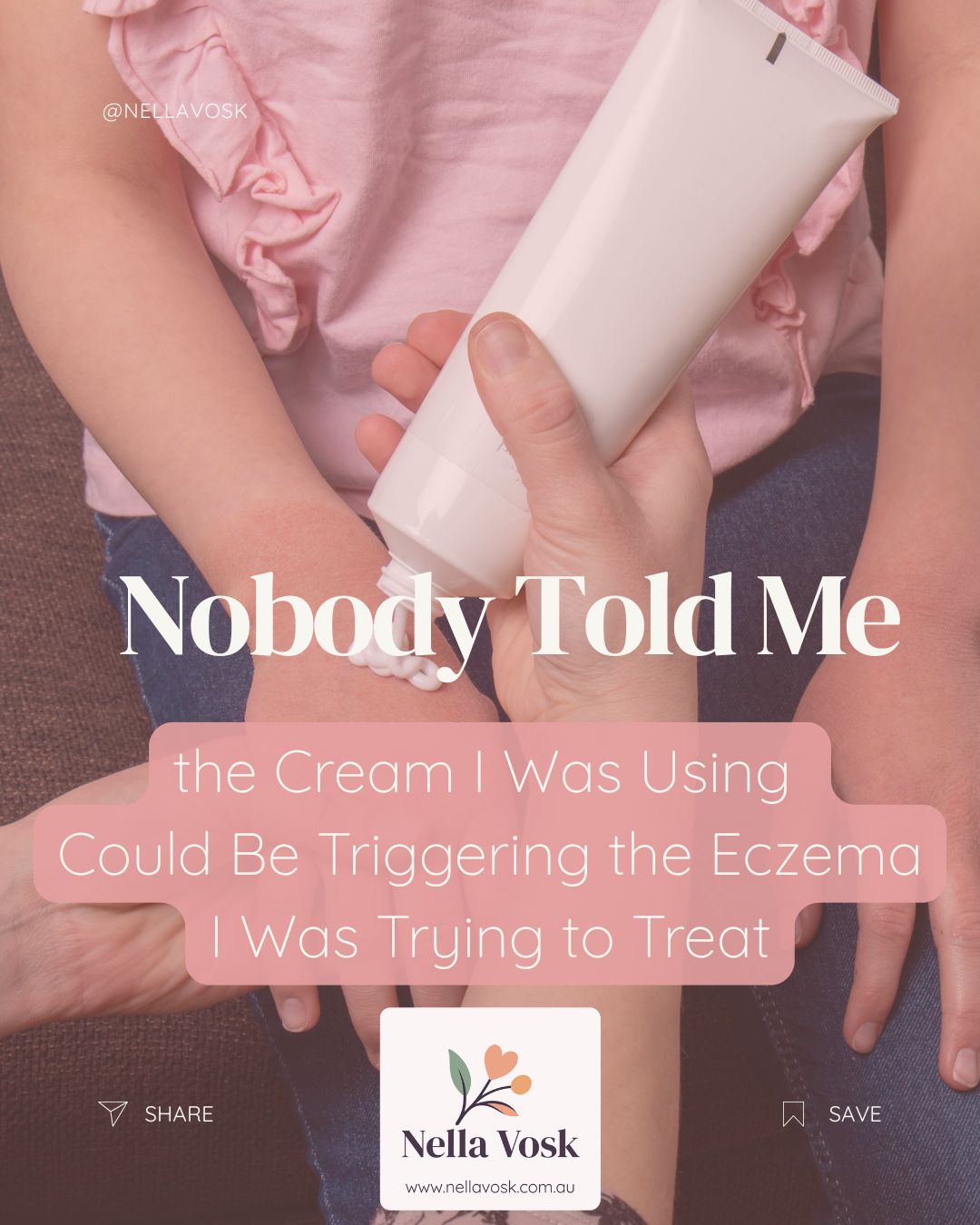
  • Nobody Told Me the Cream I Was Using Could Be Triggering the Eczema I Was Trying to Treat

    Founder of Nella Vosk • 14+ years supporting families across motherhood, feeding, and early childhood wellbeing

    Nobody Told Me the Cream I Was Using Could Be Triggering the Eczema I Was Trying to Treat

    This article is part of the Nella Vosk Complete Guide to Baby Eczema for Australian Families — everything parents managing atopic dermatitis need to know about triggers, management, and the skin barrier.

    This article is part of Nella Vosk’s Nobody Told Me series — a growing collection of posts written for the parent who has been trying everything and still feels like they’re failing their child. Every post in this series starts from a moment a parent wasn’t given information they needed, and works back through what the evidence actually says. You can find the full series at nellavosk.com.au/pages/nobody-told-me.


    Nobody told me the cream I was using could actually be triggering the eczema I was trying to treat.

    I had a bathroom shelf full of lotions. I used them religiously — multiple times a day, every day. Some were expensive. Some were marketed specifically for eczema. Some had ‘natural’ and ‘gentle’ all over the label. And the skin was still angry, still dry, still flaring.

    It took a dermatologist appointment — and a long look at the ingredient list on a product I’d been using for months — to understand that not all moisturisers work the same way on eczema-prone skin, and that some can actively make things worse. The type of product matters. The formulation matters. What’s in it matters.

    Nobody had told me any of this. Here’s what I know now.

    Ointments, Creams, and Lotions Are Not Interchangeable

    The most useful thing anyone can learn about moisturisers and eczema is the basic hierarchy of emollients: ointments are the most occlusive, creams sit in the middle, and lotions are the most watery and least effective for eczema-prone skin.

    Ointments (like petroleum jelly, white soft paraffin, or compounded paraffin preparations) contain virtually no water and a high proportion of oil. They form a strong physical seal over the skin barrier, preventing transepidermal water loss — the process by which eczema-prone skin loses moisture at a significantly higher rate than typical skin. They are greasy, difficult to apply in large quantities, and often unpopular with parents — but they are the most clinically effective option for very dry or severely flared skin. Petroleum jelly (plain, unscented) is recommended by dermatology guidelines in Australia, the UK, and the US as a first-line emollient for infant eczema.

    Creams contain a mix of water and oil held together by emulsifiers. They are easier to apply than ointments, absorb more readily, and are the most commonly used emollient format. The trade-off is that some of the emulsifiers and preservatives required to stabilise a water-oil mixture can irritate eczema-prone skin. A well-formulated, fragrance-free cream with minimal preservatives is a good daily choice; a heavily preserved or fragranced cream can be as problematic as using no emollient at all.

    Lotions are primarily water, with a small amount of oil. They spread easily, feel light, and absorb quickly — but for eczema, that means they provide only brief moisture and may leave the skin drier than before as the water evaporates. Lotions are useful on non-eczema skin and for mild dry skin, but are generally not recommended as the primary emollient for babies and children with atopic dermatitis.

    The Ingredients That Can Trigger the Eczema You’re Trying to Treat

    This is the part nobody explained to me. Some ingredients commonly found in baby moisturisers — including ones sold specifically for sensitive skin — are documented skin sensitisers in eczema-prone individuals.

    Fragrance and parfum: The single most common contact allergen in skincare. Fragrance is a collective term that can cover hundreds of individual chemical compounds. Even ‘natural’ fragrances — essential oils, botanical extracts — can trigger sensitisation. On eczema-prone skin, where the barrier is already compromised, fragrance exposure is a direct route to contact dermatitis and worsening flares. The only safe level of fragrance in an emollient for eczema-prone skin is zero.

    Preservatives — especially isothiazolinones: Methylisothiazolinone (MI) and methylchloroisothiazolinone (MCI/MIT) are preservatives used in water-containing products to prevent bacterial growth. They are among the most common causes of contact allergy in children and adults with eczema. They appear under various names on ingredient lists. A product labelled for sensitive skin may still contain them — checking the label is the only reliable way to know.

    Sodium lauryl sulphate (SLS): Found in some cream formulations as an emulsifier. SLS is a known irritant that disrupts the skin barrier — the same barrier eczema has already compromised. Aqueous Cream, once widely prescribed for eczema and still available in Australian pharmacies, contains SLS. Used as a leave-on moisturiser, it can worsen eczema rather than help it. It was formulated as a wash product, not an emollient.

    Propylene glycol and related glycols: Humectants used in many creams and lotions to attract water to the skin. In some eczema-prone individuals, particularly those with sensitised skin, glycols cause contact irritation. They appear frequently in ‘hypoallergenic’ formulations despite the sensitisation risk.

    When to Apply Matters As Much As What You Apply

    The most evidence-supported approach to emollient application in eczema is the ‘soak and seal’ method: bathe in lukewarm water for five to ten minutes using a soap-free, fragrance-free wash, pat (not rub) the skin mostly dry with a soft towel, and apply emollient within three minutes while the skin is still slightly damp. This three-minute window is clinically significant — it is when the skin is most receptive to absorbing moisture and sealing it in. Waiting longer than three minutes allows the moisture to evaporate from the surface before the emollient can lock it in. We covered the full application sequence — including what to apply first if a topical steroid is also prescribed — in NTM-2-04: Nobody Told Me the Order You Apply Skincare Matters.

    For frequency: twice daily is the research-supported minimum for emollient application in eczema. More often during flares. The skin of a baby with eczema is losing moisture at a significantly higher rate than typical skin — a twice-daily application is not overcautious, it is what the evidence supports.

    How to Choose What to Use

    The honest answer is that the brand matters less than the formulation. No particular product is universally best for every child — individual responses vary. What the research consistently supports is choosing by these criteria rather than by marketing:

    Fragrance-free: non-negotiable for eczema-prone skin. This applies to the emollient, the bath wash, and the laundry detergent.

    Minimal preservatives: fewer preservatives means fewer potential sensitisers. Look for products with short ingredient lists. Petroleum jelly (plain) has no preservatives because it contains no water — which is one reason it remains a dermatologist favourite.

    Thicker formulation: for very dry or flared skin, an ointment or thick cream will outperform a lotion every time. A product that feels greasy or heavy is often doing more work on a compromised skin barrier than a product that absorbs quickly and feels nice.

    No food-derived ingredients: oat, nut oils, goat’s milk, and other food proteins used in skincare can sensitise eczema-prone skin to those proteins before they have been introduced through eating — a mechanism with emerging evidence in food allergy development. Avoid skincare products containing food-derived ingredients on babies with eczema, particularly before those foods have been introduced through diet.

    Applying an emollient over skin that is scratched, broken, or weeping can introduce bacteria and increase infection risk. Our post on infected eczema in babies covers the signs of infection and when to stop home management and see a GP.

    The Bottom Line

    You don’t need an expensive product. You need the right type of product, with the right ingredients, applied at the right time. A plain petroleum jelly from any pharmacy, applied within three minutes of bathing, twice daily, will outperform a fragrance-preserved lotion regardless of what the lotion’s label says.

    And if the eczema is not improving despite consistent emollient use, the question worth asking is not ‘am I applying enough’ but ‘is something in this product working against the skin?’ Check the ingredient list. The answer is sometimes right there on the back of the bottle.

    Related Reading

    What Is the Best Moisturiser for Baby Eczema?

    NTM-2-04: Nobody Told Me the Order You Apply Skincare Matters with Eczema

    Is Aqueous Cream Making Your Child’s Eczema Worse?

    Wet Wrapping for Eczema: How It Works, When to Use It

    Infected Eczema in Babies: Signs, Symptoms & When to Act


    ABOUT THE AUTHOR
    Kelly Northey is a Certified Postpartum Nutrition Professional (CPPNP) and founder of Nella Vosk, the parent company of the Bamboo Bubby range. She has spent fourteen years working with Australian families navigating baby and child eczema — the sleepless nights, the skin that won’t heal, and the guilt of feeling like you should be doing more. The Bamboo Bubby range exists because of those families.
    Learn more about Kelly.


    Also in Nobody Told Me: Your Baby's Skin

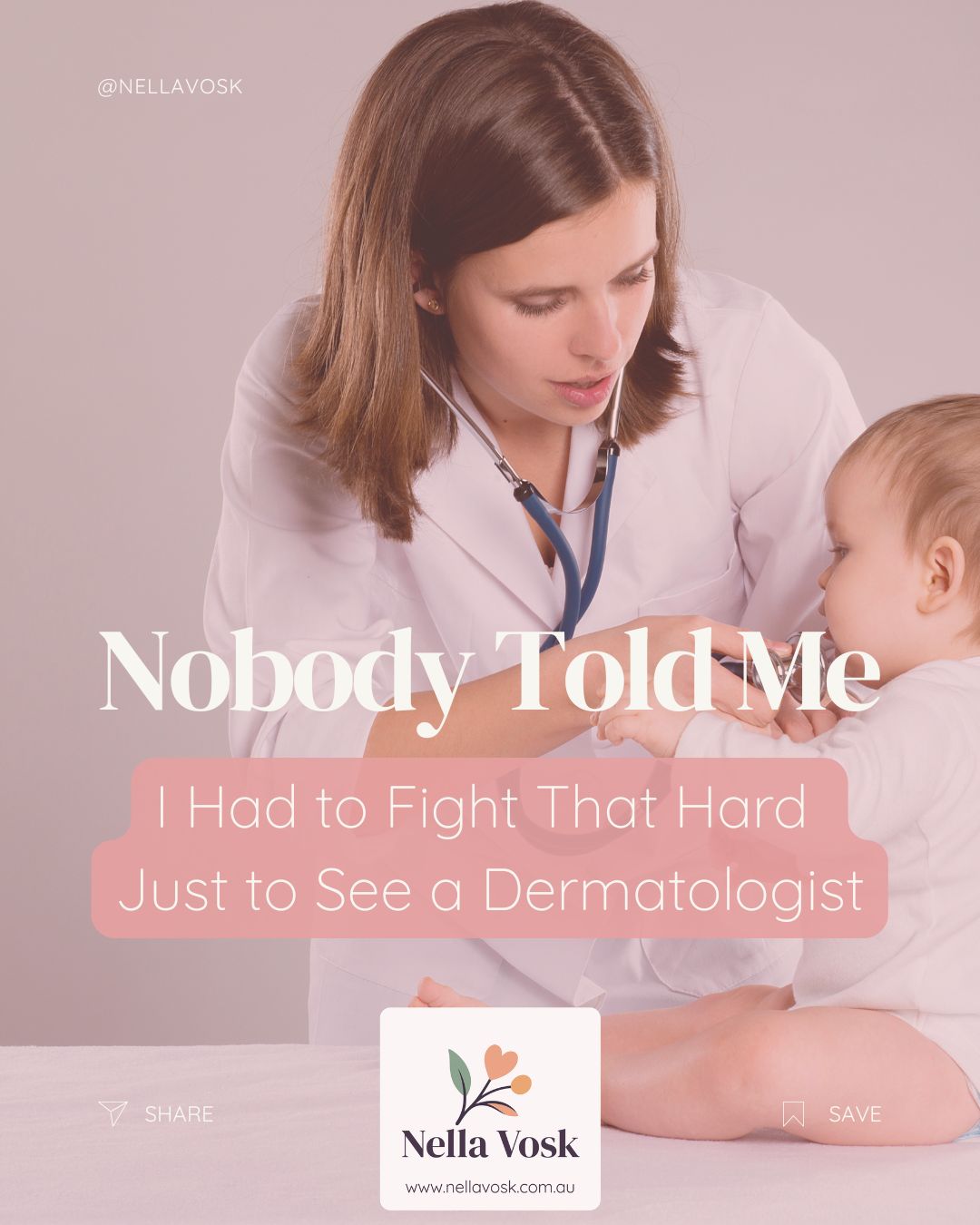
    Nobody Told Me I Had to Fight That Hard Just to See a Dermatologist
    Nobody Told Me I Had to Fight That Hard Just to See a Dermatologist

    Read More
    Nobody Told Me That the Antibiotics for the Infected Eczema Might Make the Next Infection More Likely
    Nobody Told Me That the Antibiotics for the Infected Eczema Might Make the Next Infection More Likely

    Read More
    Nobody Told Me That Adult Eczema Needs Different Management — or That My Baby’s Approach Wouldn’t Work for Mine
    Nobody Told Me That Adult Eczema Needs Different Management — or That My Baby’s Approach Wouldn’t Work for Mine

    Read More