


• Add description, images, menus and links to your mega menu

  • A column with no settings can be used as a spacer

  • Link to your collections, sales and even external links

  • Add up to five columns

  • da

  • A column with no settings can be used as a spacer

  • Link to your collections, sales and even external links

  • Add up to five columns

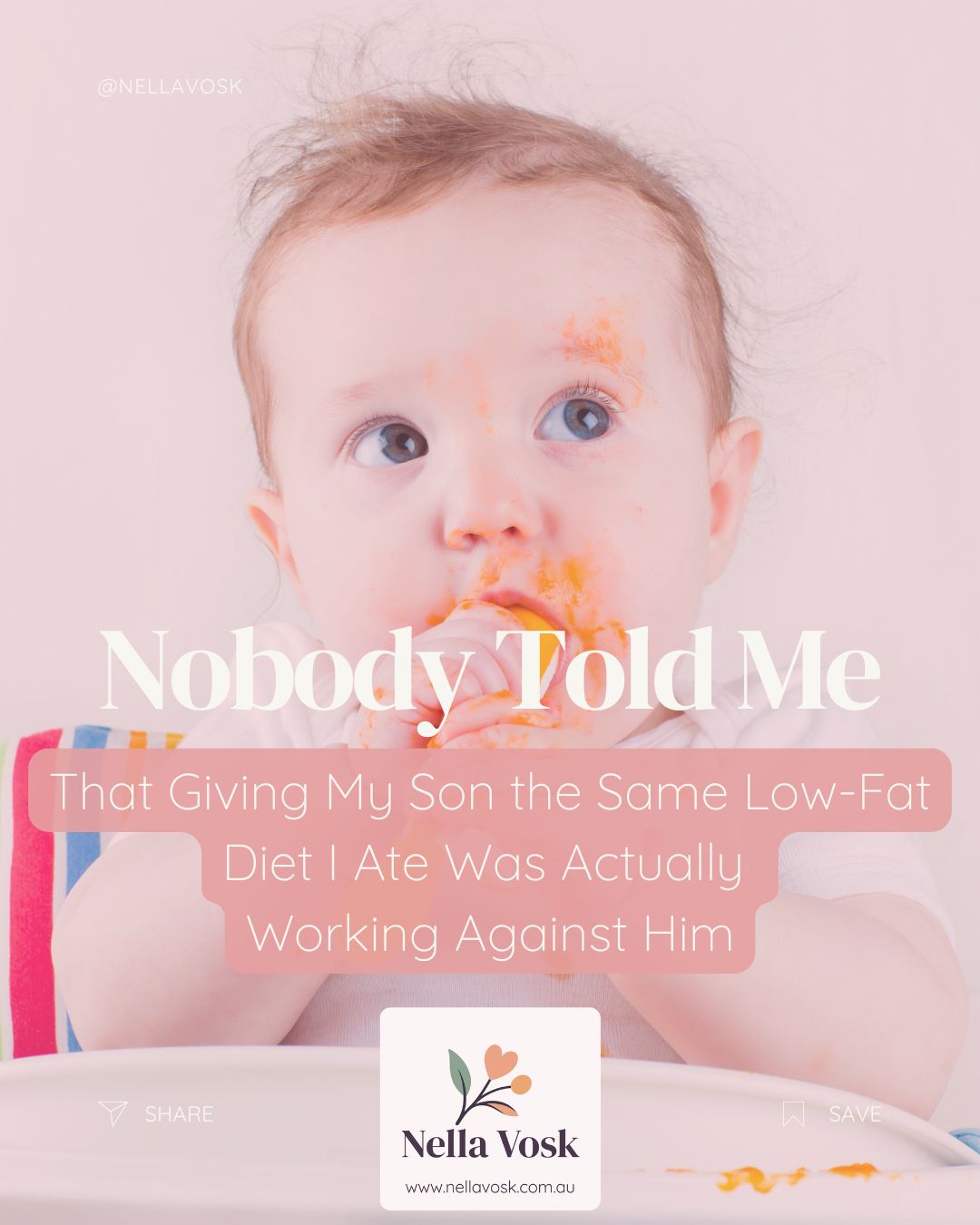
  • Nobody Told Me That Giving My Son the Same Low-Fat Diet I Ate Was Actually Working Against Him

    Founder of Nella Vosk • 14+ years supporting families across motherhood, feeding, and early childhood wellbeing

    Nobody Told Me That Giving My Son the Same Low-Fat Diet I Ate Was Actually Working Against Him

    This article is part of the Nella Vosk Baby Feeding & Solids Support Guide — evidence-based guidance for Australian families navigating the transition to solids, fussy eating, and toddler mealtimes.

    This article is part of Nella Vosk’s Nobody Told Me series — a growing collection of posts written for the parent who has been trying everything and still feels like they’re failing their child. Every post in this series starts from a moment a parent wasn’t given information they needed, and works back through what the evidence actually says. You can find the full series at nellavosk.com.au/pages/nobody-told-me.


    Nobody told me that giving my son the same low-fat diet I ate was actually working against him.

    I had spent years moderating my own fat intake — choosing reduced-fat dairy, trimming visible fat from meat, being cautious about oils and butter. These habits were well-intentioned and broadly appropriate for an adult woman trying to eat sensibly. When my son transitioned to solids and began eating family food, I applied the same thinking automatically. Low-fat yoghurt. Reduced-fat milk at twelve months. Careful with avocado. Cautious with cheese.

    Nobody had told me that the nutritional requirements of a toddler’s rapidly developing brain are categorically different from those of an adult. That fat is not simply a macronutrient to be managed carefully but the primary building material and fuel source for a nervous system in its most intensive growth phase. That the low-fat approach I had applied to my own diet for years was, when applied to my toddler, potentially working directly against the developmental process I was trying to support.

    Why Toddlers Need More Fat Than Adults

    The brain at birth is approximately 25% of its adult size. By age three, it reaches approximately 80%. This extraordinary rate of growth requires fat — specifically, the structural fats that form the myelin sheaths around nerve fibres, the phospholipids in cell membranes, and the long-chain polyunsaturated fatty acids (particularly DHA and arachidonic acid) that support neural development and connectivity.

    Fat provides 9 kilojoules per gram — more than double the energy provided by carbohydrate or protein. For a toddler with a small stomach and high energy needs relative to their body size, energy-dense foods are particularly valuable. A toddler eating a low-fat diet must eat a significantly larger volume of food to meet their energy requirements than a toddler eating a diet with appropriate fat content — and given that toddler appetite is variable, small stomach capacity is a limiting factor, and food refusal is developmentally normal, this volume requirement is often not met.

    Australian dietary guidelines reflect this explicitly. The Australian Dietary Guidelines recommend full-fat dairy products for children under two, and do not recommend fat restriction in children under the age of two at all. The Heart Foundation and Nutrition Australia position statements are consistent: the low-fat, reduced-saturated-fat approach that is evidence-appropriate for adults managing cardiovascular risk is not evidence-appropriate for toddlers, and applying it in this developmental window can produce genuine nutritional inadequacy.

    Do Toddlers Need Fat in Their Diet?

    Yes — and in proportions that would concern most Australian adults if they thought about it in the context of their own diet. The NHMRC guidelines for children aged one to three suggest that approximately 30–40% of total energy intake should come from fat. This is substantially higher than the 20–35% recommended for adults in cardiovascular risk reduction guidelines. For a child eating approximately 5,000–6,000 kilojoules per day, this means approximately 40–55 grams of total fat daily.

    This is not a target most parents are actively trying to hit — and most toddlers eating a varied diet that includes full-fat dairy, eggs, meat, fish, and plant fats like avocado and nut butters will meet it without specific intervention. The problem arises when fat is actively restricted — through the use of reduced-fat dairy, the trimming of fat from meat, the avoidance of butter and oils, or a diet that leans heavily on low-fat breakfast cereals and crackers — or when the toddler’s food variety is so limited that high-fat foods are consistently absent.

    Healthy Fats for Toddler Brain Development

    Not all fats play the same role in toddler development. Understanding the fat types helps make more deliberate food choices.

    DHA (docosahexaenoic acid): a long-chain omega-3 fatty acid that is the most abundant structural fat in the brain and retina. DHA accumulates rapidly in the brain during the first three years of life and is essential for visual and cognitive development. Breast milk provides DHA directly; after weaning, dietary sources become the primary supply. The richest food sources are oily fish (salmon, sardines, mackerel, tuna) and eggs from DHA-enriched hens. Plant sources of omega-3 (walnuts, flaxseed, chia) provide ALA, which converts to DHA at low efficiency in children. Oily fish two to three times per week is the most reliable way to meet toddler DHA needs from food.

    Arachidonic acid (AA): a long-chain omega-6 fatty acid that, together with DHA, is the primary structural fat in brain tissue. Found in meat, eggs, and dairy. A toddler eating a varied diet that includes animal proteins will typically meet AA requirements without specific attention.

    Saturated fat: found in full-fat dairy, meat, butter, and coconut oil. Saturated fat in the toddler diet is not the cardiovascular concern it is for adults. Australian guidelines explicitly recommend full-fat dairy under two precisely because the saturated fat content is part of the energy and fat profile appropriate to this developmental stage. The research on saturated fat restriction in toddlers does not support the adult-derived concern; the key is overall dietary quality and variety, not specific restriction of saturated fat.

    Unsaturated fats: monounsaturated fats (avocado, olive oil, nuts) and polyunsaturated fats (oily fish, walnuts, seeds) contribute to the variety of fat-soluble nutrient delivery alongside their direct fat contribution. Avocado is particularly useful for toddlers — it provides a combination of healthy fat, vitamin E, and folate in a texture that is easy to modify for different developmental stages.

    When Can Toddlers Have Low-Fat Milk?

    This is one of the most common questions parents have around the twelve-month transition from infant formula or breast milk to cow’s milk. The evidence-based answer in Australia is clear: full-fat cow’s milk (not reduced-fat, not low-fat, not skim) is recommended from twelve months to two years. After two, reduced-fat varieties become appropriate if the child is eating a varied diet with adequate fat from other sources.

    The reason is straightforward: full-fat milk provides a concentration of fat-soluble vitamins (A, D, E, K) and energy that reduced-fat milk does not. A toddler drinking 250–500ml of full-fat milk daily is getting a meaningful contribution to their fat and energy intake from that source. Switching to reduced-fat milk at twelve months, as many parents do by instinct or by following adult dietary habits, removes a significant fat source from the diet at the developmental stage when it is most needed.

    Practical High-Fat Foods for Toddlers

    The goal is not to add supplemental fat to a toddler’s diet but to ensure that fat-containing whole foods are consistently present and not systematically avoided.

    Full-fat dairy: full-fat yoghurt, full-fat cheese (soft cheeses like ricotta and cream cheese as well as harder cheeses), and full-fat cow’s milk from twelve months. These provide fat, protein, calcium, and fat-soluble vitamins in a format most toddlers accept readily.

    Eggs: a complete fat and protein package that also provides DHA, choline, and fat-soluble vitamins. Scrambled, hard-boiled, in omelettes or frittatas — eggs are one of the most versatile and nutritionally complete toddler foods available.

    Oily fish: salmon, sardines, and mackerel provide the best dietary DHA available. Canned salmon and sardines mixed into pasta or rice, or flaked into finger food pieces, are practical toddler formats. Aim for two to three serves per week.

    Avocado: a monounsaturated fat source that is soft, versatile, and widely accepted by toddlers. Mashed, sliced, or blended into dips and sauces. The fat content makes it calorie-dense, which is an advantage rather than a concern for a toddler.

    Nut and seed butters: peanut butter, almond butter, tahini, and sunflower seed butter are concentrated fat, protein, and mineral sources. On toast, stirred into porridge, or as a dip. Note allergen introduction guidelines for nut butters — early introduction (before twelve months) is recommended for reducing allergy risk, not delaying it.

    Meat and poultry: the fat in meat provides energy, fat-soluble vitamins, and arachidonic acid. There is no reason to trim visible fat from meat served to toddlers. Slow-cooked meats that are fatty and tender are often easier for toddlers to manage texturally than lean cuts.

    Butter and olive oil: used in cooking and on food, these add fat without requiring additional volume of food. Butter on toast or vegetables is appropriate for toddlers. Olive oil on pasta or drizzled over roasted vegetables adds energy density without competing for limited stomach space.

    What About a Toddler Who Is a Picky Eater?

    The picky eating picture and the fat intake picture intersect in an important way: many of the foods that toddlers commonly refuse are the highest-fat foods. Oily fish, avocado, cheese, eggs, and nut butters are all foods that toddlers with neophobia or texture sensitivity may reject consistently. When these foods are absent from the diet, fat intake can become genuinely inadequate.

    The exposure model applies here as it does to all foods: consistent low-pressure offering, without expectation of eating, over many months. The practical priority is to ensure that at least some fat-containing foods are offered at most meals, and that the overall diet includes regular appearances of the highest-fat-density foods even when they are not being eaten. A child who refuses salmon at thirty consecutive meals but sees it on the table at each one is still accumulating the exposure that eventually leads to acceptance.

    The iron deficiency post in this series — NTM-3-04 — is worth reading alongside this one. The foods richest in iron for toddlers (red meat, legumes, eggs) overlap significantly with the foods richest in healthy fat. A toddler eating a varied diet that covers iron needs is usually also covering fat needs, and vice versa. Both gaps tend to appear together in very narrow diets.

    Related Reading

    Nobody Told Me About Iron Deficiency in Toddlers

    Nobody Told Me That Refusing Food Was My Son’s Job

    First Foods for Eczema Babies: Safe Introduction Guide

    Baby Feeding & Solids Support — Nella Vosk


    ABOUT THE AUTHOR
    Kelly Northey is a Certified Postpartum Nutrition Professional (CPPNP) and founder of Nella Vosk. She has spent fourteen years working with Australian families navigating the full arc of feeding — from breastfeeding and first foods through toddler mealtimes and the anxiety that so often surrounds them. The MunchyTime range exists because mealtimes should be low-stakes, not a battleground.
    Learn more about Kelly.


    Also in Nobody Told Me: Your Toddler at the Table

    Nobody Told Me That the TV I Left on During Dinner Was Making Him Less Likely to Eat
    Nobody Told Me That the TV I Left on During Dinner Was Making Him Less Likely to Eat

    Read More
    Nobody Told Me I Had to Choose
    Nobody Told Me I Had to Choose

    Read More
    Nobody Told Me That My Stress About What He Ate Was Showing Up on His Plate
    Nobody Told Me That My Stress About What He Ate Was Showing Up on His Plate

    Read More