• Add description, images, menus and links to your mega menu

  • A column with no settings can be used as a spacer

  • Link to your collections, sales and even external links

  • Add up to five columns

  • da

  • A column with no settings can be used as a spacer

  • Link to your collections, sales and even external links

  • Add up to five columns

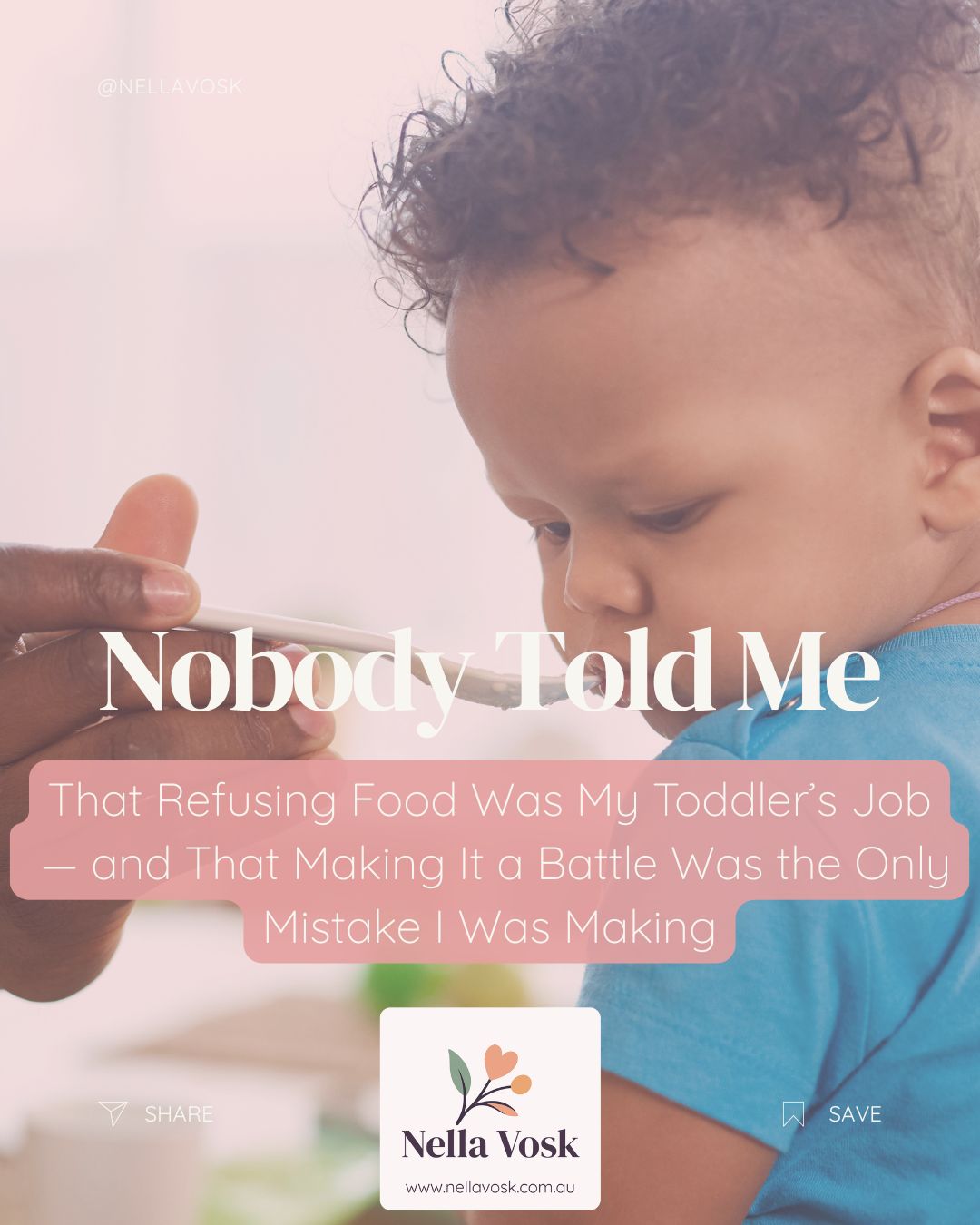
  • Nobody Told Me That Refusing Food Was My Toddler’s Job — and That Making It a Battle Was the Only Mistake I Was Making

    Founder of Nella Vosk • 14+ years supporting families across motherhood, feeding, and early childhood wellbeing

    Nobody Told Me That Refusing Food Was My Toddler’s Job — and That Making It a Battle Was the Only Mistake I Was Making

    This article is part of the Nella Vosk Baby Feeding & Solids Support Guide — evidence-based guidance for Australian families navigating the transition to solids, fussy eating, and toddler mealtimes.

    This article is part of Nella Vosk’s Nobody Told Me series — a growing collection of posts written for the parent who has been trying everything and still feels like they’re failing their child. Every post in this series starts from a moment a parent wasn’t given information they needed, and works back through what the evidence actually says. You can find the full series at nellavosk.com.au/pages/nobody-told-me.


    Nobody told me that refusing food was my toddler’s job — and that making it a battle was the only mistake I was making.

    By the time my daughter was two and a half, mealtimes had become the thing I dreaded most about the day. She had been a reasonable eater as a baby — not adventurous, but manageable. And then, somewhere around eighteen months, something shifted. Foods she had eaten without complaint were suddenly met with a flat hand or a turned head. New foods didn’t stand a chance. Dinner was a negotiation I consistently lost, and I was ending most evenings feeling like I had failed at one of the most basic things a parent is supposed to be able to do: feed her child.

    What nobody told me was that this was not a problem I had caused. It was not a reflection of my cooking, my consistency, or my parenting. It was a developmental stage with a name, an evolutionary explanation, and a body of research behind it — and the approach I had instinctively defaulted to (coaxing, encouraging, negotiating, occasionally bribing) was, according to that research, making it worse rather than better.

    Understanding what was actually happening at the table changed everything about how I approached it.

    What Is Neophobia and Why Does Every Toddler Have It?

    Food neophobia — a wariness of or aversion to new or unfamiliar foods — is a hardwired developmental trait that peaks in most children between the ages of two and six. It is not pickiness in the colloquial sense. It is not stubbornness, or manipulation, or a preference for beige food. It is an evolved protective mechanism.

    The evolutionary logic is straightforward: a toddler who has recently become mobile enough to put things in their mouth without parental oversight is at significant risk of accidental poisoning. Many naturally occurring toxins in plants taste bitter. A toddler brain that is wary of unfamiliar foods — that defaults to rejection of anything new until sufficient evidence of safety is established — is a toddler brain that is doing exactly what evolution built it to do.

    This does not make it less exhausting to live with. But it changes the frame completely. A toddler who refuses a new food is not being difficult. They are being developmentally appropriate. The refusal is not aimed at you. It is not a verdict on your cooking. It is a nervous system doing its job.

    Neophobia affects both food acceptance and previously accepted foods. The child who ate broccoli at twelve months and refuses it at twenty-four months is not being perverse. Their developing cognitive awareness of food categories, textures, and novelty has simply caught up with their motor ability. This is why the phase often feels like a regression — because in the narrow sense of accepted foods, it briefly is one.

    What the Research Says About Pressure at Mealtimes

    The research on child feeding behaviour is consistent on one point: pressure produces worse outcomes than patience.

    Pressure at mealtimes — coaxing, encouraging, bargaining, rewarding, hiding vegetables in other foods, using distraction — is associated with increased food refusal over time, not decreased. The mechanisms are multiple. Pressure draws a child’s attention to the food being refused, increasing its emotional salience. It creates a power dynamic at the table that the child can win simply by not eating. And critically, it short-circuits the process by which children actually come to accept new foods: repeated, low-stakes, unpressured exposure.

    Children need to encounter a food many times — research suggests somewhere between ten and twenty exposures, and sometimes significantly more — before accepting it. These exposures don’t all need to involve eating. Seeing a food on the table. Touching it. Smelling it. Watching another person eat it without drama. Each of these is a legitimate step in the exposure ladder. A child who refuses a food and is pressured to eat it learns that mealtimes involving that food are stressful. A child who refuses a food and experiences no consequence learns, gradually and at their own pace, that the food is safe.

    This is counterintuitive for most parents, because it feels like doing nothing. It is not doing nothing. It is doing the one thing that actually works: maintaining low-pressure, repeated exposure without attaching emotional weight to whether the food is eaten.

    Why ‘Just Try One Bite’ Doesn’t Work

    ‘Just try one bite’ is perhaps the most well-intentioned and least effective strategy in the toddler feeding toolkit. The logic seems sound: one bite is a low bar, and if they taste it, they might like it.

    The problem is that ‘just try one bite’ is still pressure. It puts the child in a position where eating is required to satisfy a parental expectation. It makes refusal a confrontation rather than a neutral outcome. And it places the emphasis on eating rather than on exposure — which is where the actual acceptance process happens.

    Research on systematic exposure approaches consistently finds that children who experience food without eating pressure show faster acceptance timelines than children who are encouraged or required to taste. The bite requirement, however small, is still a requirement — and toddlers are exquisitely sensitive to the emotional tone of a mealtime.

    The Division of Responsibility at the Table

    The framework that has the strongest evidence base for toddler feeding is Ellyn Satter’s Division of Responsibility — a model developed over decades of clinical feeding work that draws a clear line between what the parent is responsible for and what the child is responsible for.

    The parent’s job: to decide what food is offered, when it is offered, and where eating happens. The parent chooses the menu, provides a variety of foods at each meal, and creates a calm, distraction-reduced mealtime environment.

    The child’s job: to decide whether to eat any given food, and how much. The child has full jurisdiction over what goes in their mouth. No amount of negotiation, encouragement, or reward changes this jurisdiction — and attempting to override it consistently produces worse feeding outcomes.

    What the Division of Responsibility does in practice is remove the battle from the table. There is no battle if the parent is genuinely not invested in whether a particular food is eaten. The food is offered. The child decides. The mealtime ends. This is not permissive parenting — the parent is still firmly in charge of what is served. But within that structure, the child’s bodily autonomy over eating is respected entirely.

    Most parents who encounter this framework report two things: initial scepticism (it seems too passive) and genuine surprise at how quickly the mealtime tension reduces once the expectation of eating is removed from the child’s side of the equation.

    What About Nutrition?

    The most common anxiety driving mealtime pressure is nutritional: if the child doesn’t eat this, are they getting enough? This is a legitimate concern and deserves a direct answer.

    Toddler nutritional needs are smaller than most parents assume. A toddler’s stomach is approximately the size of their fist. The amounts that constitute an adequate intake at this age are genuinely small by adult standards. Research on toddler self-regulation consistently shows that children who are allowed to determine their own intake (within a structured mealtime framework) eat appropriate amounts over time, even when individual meals are irregular or apparently inadequate.

    The foods most commonly refused — vegetables, proteins, mixed dishes — are not always the ones most critical to toddler nutrition. A toddler who reliably eats dairy, fruit, starchy carbohydrates, and some protein across the week is likely meeting most of their nutritional needs even when dinner is a catastrophe. The exception — iron deficiency, which is the most common nutritional gap in Australian toddlers — is worth monitoring specifically and is something we cover in a later post in this series.

    If there is genuine concern about nutritional adequacy — poor weight gain, extreme dietary restriction over a sustained period, or signs of nutritional deficiency — a GP or paediatric dietitian is the right resource. But most toddler fussy eating, however dramatic it looks at the table, does not produce nutritional deficiency in otherwise healthy children eating across a broad enough range of food groups.

    The One Thing That Changes Everything

    If there is a single shift that the feeding research supports most strongly, it is this: eat together, serve the same food to everyone, and do not comment on what the child eats or doesn’t eat.

    Family meals are one of the most consistently protective factors in child feeding outcomes. Children who eat at a shared table with adults who are eating the same food learn, through observation and normalisation, that the food is something people eat. This is more powerful than any amount of encouragement.

    The no-comment rule is equally important. Praise for eating (‘good job eating your broccoli!’) is a form of pressure — it signals that eating was a performance that required positive reinforcement. Negative comment is obviously counterproductive. The goal is a mealtime where food is present, available, and utterly uncontested — where the emotional temperature around the table is as low as possible, and the child’s relationship with food can develop without the anxiety of parental expectation attached to every meal.

    The Nella Vosk Baby Feeding & Solids Support page covers the full picture of feeding from first foods through toddler mealtimes — including the equipment and environment factors that make a difference to how a toddler engages at the table.

    What to Say When You Feel Like You’re Failing

    Most parents managing toddler food refusal are not failing. They are in the middle of a developmental stage that is genuinely difficult, that nobody prepared them for, and that they are handling with the tools they were given — which are usually the wrong tools, because the right ones are counterintuitive.

    The mum who sits down at dinner every night and watches her toddler refuse three-quarters of what she cooked is not doing something wrong. She is living through neophobia peak. The research says it passes. It says the low-pressure exposure approach works. It says that children who are fed without mealtime battles grow into more varied eaters than children whose families fought every dinner.

    Nobody told her any of that. That’s what this series is for.

    Related Reading

    Baby Feeding & Solids Support — Nella Vosk

    First Foods for Eczema Babies: Safe Introduction Guide

    Allergen Introduction for Eczema Babies — ASCIA Guidelines

    MunchyTime Baby-Led Weaning Feeding Set


    ABOUT THE AUTHOR
    Kelly Northey is a Certified Postpartum Nutrition Professional (CPPNP) and founder of Nella Vosk. She has spent fourteen years working with Australian families navigating the full arc of feeding — from breastfeeding and first foods through toddler mealtimes and the anxiety that so often surrounds them. The MunchyTime range exists because mealtimes should be low-stakes, not a battleground.
    Learn more about Kelly.


    Also in Nobody Told Me: Your Toddler at the Table

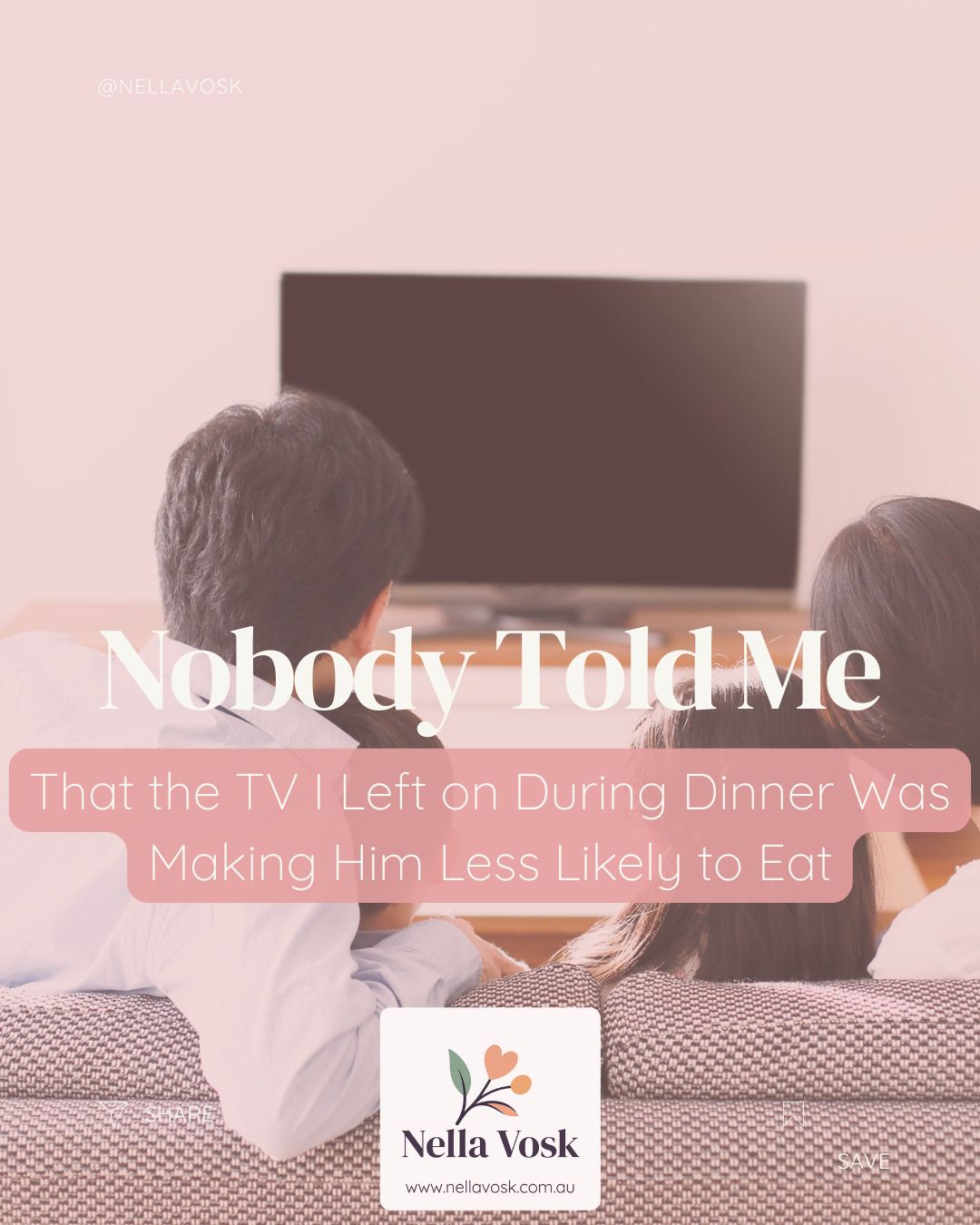
    Nobody Told Me That the TV I Left on During Dinner Was Making Him Less Likely to Eat
    Nobody Told Me That the TV I Left on During Dinner Was Making Him Less Likely to Eat

    Read More
    Nobody Told Me I Had to Choose
    Nobody Told Me I Had to Choose

    Read More
    Nobody Told Me That Giving My Son the Same Low-Fat Diet I Ate Was Actually Working Against Him
    Nobody Told Me That Giving My Son the Same Low-Fat Diet I Ate Was Actually Working Against Him

    Read More