

• Add description, images, menus and links to your mega menu

  • A column with no settings can be used as a spacer

  • Link to your collections, sales and even external links

  • Add up to five columns

  • da

  • A column with no settings can be used as a spacer

  • Link to your collections, sales and even external links

  • Add up to five columns

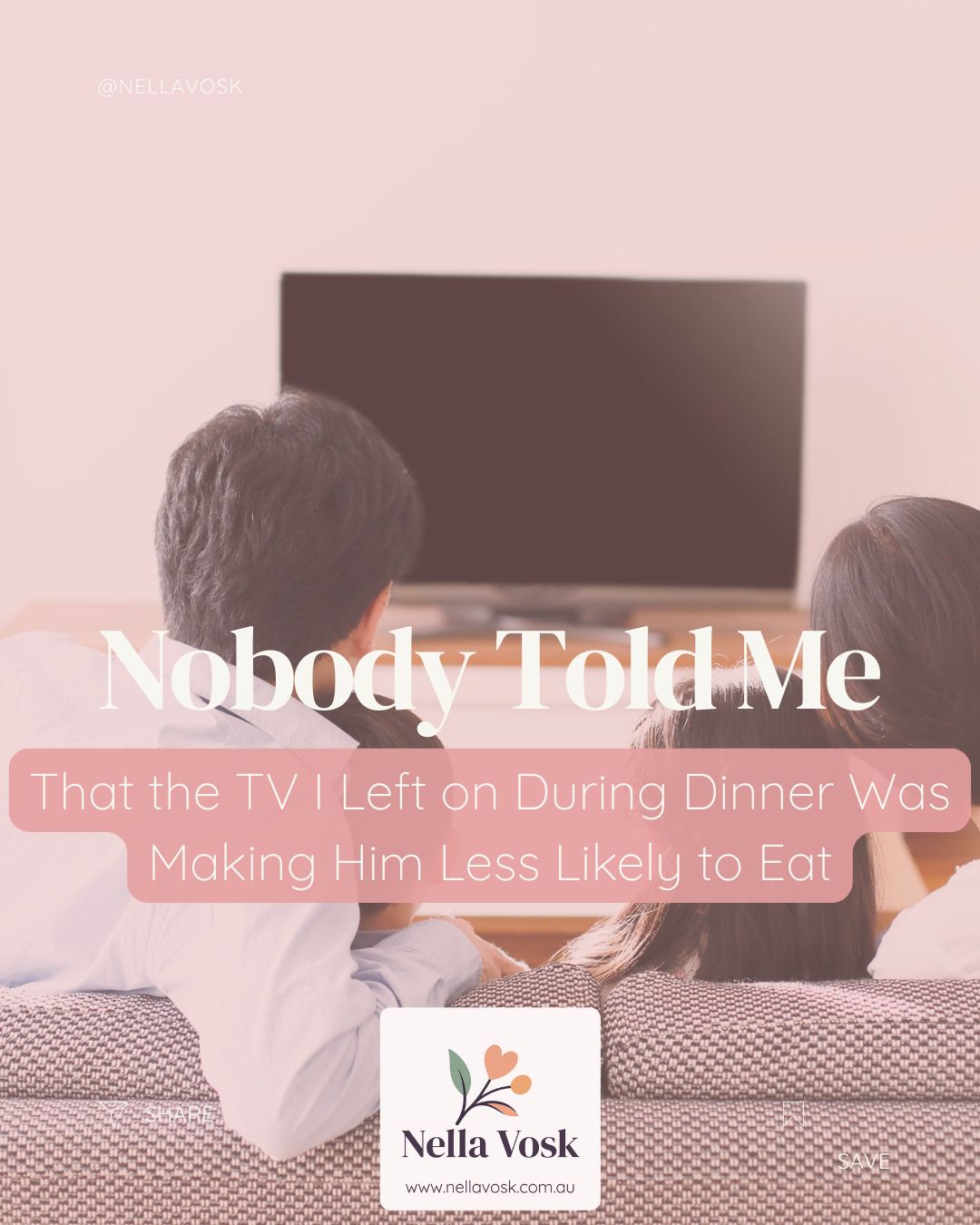
  • Nobody Told Me That the TV I Left on During Dinner Was Making Him Less Likely to Eat

    Founder of Nella Vosk • 14+ years supporting families across motherhood, feeding, and early childhood wellbeing

    Nobody Told Me That the TV I Left on During Dinner Was Making Him Less Likely to Eat

    This article is part of the Nella Vosk Baby Feeding & Solids Support Guide — evidence-based guidance for Australian families navigating the transition to solids, fussy eating, and toddler mealtimes.

    This is the final post in Nella Vosk’s Nobody Told Me series — 52 posts across three chapters, written for the parent who has been trying everything and still feels like they’re failing their child. Every post starts from a moment a parent wasn’t given information they needed, and works back through what the evidence actually says. The full series lives at nellavosk.com.au/pages/nobody-told-me.


    Nobody told me that the TV I left on during dinner was making him less likely to eat.

    It had started as a practical decision. My son ate better — or at least more — when there was something on in the background. He was calmer. He stayed at the table longer. He opened his mouth more readily. I had mentally filed this under ‘whatever works’ and not examined it further.

    What I hadn’t understood was the mechanism. The apparent improvement in how much he ate during distracted mealtimes was not an improvement in appetite or food acceptance. It was dissociation from his own hunger and fullness signals. A toddler eating while watching TV is not attending to the experience of eating — they are not registering flavour, texture, or satiety in the same way. They may take more bites, but the bites are not connected to hunger. And the food they are most likely to accept in this dissociated state is not vegetables — it is the simplest, most palatable, least challenging items on the plate.

    Australian research published in 2022 followed 352 families of children aged six months to six years for two years and found that daily mealtime television use was associated with higher intake of discretionary foods (less nutritious foods) at the two-year follow-up. Not by a small margin. The effect was consistent across breakfast, lunch, and dinner. The TV was not making the mealtime better. It was making the diet worse. Nobody had told me.

    Why the Mealtime Environment Matters

    The research on mealtime environment and toddler eating is consistent across decades and populations. The physical and sensory context in which a child eats is not a neutral backdrop to the food on the plate — it is an active variable that influences appetite, food acceptance, and dietary quality.

    There are several reasons for this. Eating is a regulatory activity that requires the nervous system to be in a sufficiently calm, attentive state. When the environment demands attentional resources — through noise, screens, competing stimulation — those resources are unavailable for the internal signals that regulate eating: hunger, satiety, flavour registration, texture processing. The child eats on autopilot rather than in response to their body’s actual signals.

    Additionally, the mealtime environment shapes what the child associates with food. A mealtime that is consistently calm, predictable, and social trains the nervous system to anticipate a low-threat experience around food. A mealtime that is consistently overstimulating, hurried, or tense trains the nervous system to arrive at the table in a state that is not conducive to trying new foods or eating comfortably.

    The TV and Screen Question

    Screens at mealtimes — whether television in the room, a tablet propped on the table, or a phone held by the parent — are consistently associated with worse eating outcomes in the research. This applies to screens used to settle the child and screens used to occupy the parent. The mechanism is the same: attention that would otherwise be available for the eating experience is directed elsewhere.

    The specific concern about using screens to encourage eating — the ‘he eats better with the TV on’ pattern — is that it trains the child to eat only when distracted, which makes eating without screens progressively harder. Parents who report that their toddler ‘only eats when watching TV’ have usually inadvertently created this association through repeated distraction-assisted mealtimes. The child has learned that eating happens during screen time, and eating without it is unfamiliar and unreinforced.

    Reversing this pattern takes time and consistency. The transition to screen-free mealtimes works best when done gradually — reducing screen time incrementally over several weeks rather than abruptly removing it — combined with making the mealtime itself as pleasant and low-pressure as possible. Screen-free does not need to mean silent or formal. A mealtime with conversation, a familiar routine, and calm family presence is a positive experience that gradually replaces the screen as the mealtime association.

    Timing: The Most Overlooked Variable

    The timing of meals relative to hunger and tiredness is one of the most significant and most overlooked mealtime environment variables. A toddler who is not hungry will not eat well regardless of what is served or how calm the environment is. A toddler who is overtired will not engage calmly with food regardless of how well the mealtime is set up.

    Nap timing: a toddler who has recently woken from a nap is often not hungry for thirty to forty-five minutes. Offering dinner immediately after a nap frequently produces the disengaged, fussy mealtime that parents interpret as food refusal. Waiting until hunger has had time to build after a nap produces a meaningfully different mealtime.

    Gap since last meal or snack: structured mealtimes work best when there is a gap of at least two to three hours since the last eating occasion. A toddler who has been grazing — small amounts of food throughout the day without structured mealtimes — arrives at dinner without appetite. This is one of the most common patterns underlying the ‘my toddler doesn’t eat dinner’ experience, and it is an environment problem, not a food problem.

    Time of day: many toddlers have a late-afternoon energy dip that overlaps with typical dinner preparation time. A tired toddler is a reactive toddler, and reactive toddlers have lower frustration tolerance for challenging foods. A dinner served slightly earlier — while the toddler is still in a regulated state — often produces better eating than the same meal served forty minutes later when tiredness has accumulated.

    Seating and Physical Setup

    A toddler who is physically stable and supported eats better than a toddler who is physically insecure. This is not intuitive to most parents, but it makes physiological sense: when the body is using energy to maintain balance and stability, fewer resources are available for the focused motor skills involved in self-feeding.

    A high chair or booster seat that positions the toddler with hips at ninety degrees, feet supported (not dangling), and a tray or table at an appropriate height creates the physical stability from which confident, competent eating develops. A toddler sitting in a chair that is too large, with their feet hanging, is expending effort maintaining posture that could otherwise be directed toward engaging with food.

    The appropriate utensil size and weight also matter here — a spoon that is too large for the child’s hand, a fork with tines too long to control, a bowl that moves every time a spoon pushes against it all add physical difficulty to an already complex developmental task. The right equipment reduces the physical load, which allows more of the child’s attention to go toward the food itself. This is the developmental argument behind purpose-designed toddler feeding equipment — not aesthetics, but reduced motor demand.

    Noise and Sensory Load

    For most children, a noisy mealtime environment does not significantly affect eating. For children who are sensory-sensitive — a proportion discussed in NTM-3-07 in this series — background noise, competing sounds, strong smells from cooking, and the overall sensory load of the kitchen environment can meaningfully affect their capacity to eat comfortably.

    This is worth naming separately because it is sometimes missed: a child who consistently eats better in a quieter environment, who seems more overwhelmed than usual when there is background noise during meals, or who eats differently at a calm restaurant table versus a busy family kitchen may have a sensory component to their mealtime difficulties that is environmental rather than food-related. Adjusting the sensory environment — eating in a quieter room, reducing background noise, ensuring the child is not overwhelmed before the meal begins — can produce meaningful improvements without any change to what is served.

    The Small Changes That Make a Difference

    The mealtime environment does not need to be perfect. The research does not describe a serene, orchestrated family dinner as the prerequisite for good toddler eating. What it describes is a consistent, low-stimulation, reliably structured context that allows the toddler’s nervous system to arrive at the table in a state that supports eating.

    The single highest-impact change: screens off for the duration of the meal. Not at the beginning, not most nights, but consistently. This one change — consistently implemented over several weeks — is the most reliably evidence-supported mealtime environment modification available.

    The second change: a consistent meal schedule with appropriate gaps between eating occasions, and dinner timed before the late-afternoon overtiredness window rather than within it.

    The third change: check the physical setup. Are feet supported? Is the seating height appropriate? Does the bowl move? Is the spoon the right size?

    These are small, practical, free, and often overlooked. Before changing the food, the approach, or the strategy — check the environment.

    A Note to Close the Series

    This is the last post in the Nobody Told Me series — the 52nd piece of information that nobody told you, across three chapters and three ranges, written for the parent who has been doing everything right and still wondering why it isn’t working.

    What I want you to take from this series, more than any individual post, is the same thing that runs through all of it: the reason you’re struggling is almost never that you’re failing. It’s almost always that nobody told you something you needed to know. The six-week check didn’t tell you about postpartum depletion. The midwife didn’t tell you about the night milk. The paediatrician didn’t explain that eczema isn’t your fault. Nobody told you that food refusal is developmental, that fifteen exposures is just the beginning, that the mealtime environment might be the thing to change before the food.

    That information gap is what Nella Vosk exists to fill. And this series was our attempt to fill it — honestly, specifically, in the clinical detail that the system consistently failed to provide.

    The full Nobody Told Me series — all 52 posts across Chapter 1 (Nourish Mama), Chapter 2 (Bamboo Bubby), and Chapter 3 (Nobody Told Me at the Table) — is at nellavosk.com.au/pages/nobody-told-me.

    Related Reading

    Nobody Told Me That Just Sitting Down Together Was Doing More Than I Realised

    Nobody Told Me That My Stress About What He Ate Was Showing Up on His Plate

    Nobody Told Me That What Looked Like Stubbornness Might Be Sensory

    Baby Feeding & Solids Support — Nella Vosk

    The Nobody Told Me Series — All 52 Posts


    ABOUT THE AUTHOR
    Kelly Northey is a Certified Postpartum Nutrition Professional (CPPNP) and founder of Nella Vosk. She has spent fourteen years working with Australian families navigating the full arc of feeding — from breastfeeding and first foods through toddler mealtimes and the anxiety that so often surrounds them. The Nobody Told Me series is the thing she wishes had existed when she needed it most.
    Learn more about Kelly.


    Also in Nobody Told Me: Your Toddler at the Table

    Nobody Told Me I Had to Choose
    Nobody Told Me I Had to Choose

    Read More
    Nobody Told Me That Giving My Son the Same Low-Fat Diet I Ate Was Actually Working Against Him
    Nobody Told Me That Giving My Son the Same Low-Fat Diet I Ate Was Actually Working Against Him

    Read More
    Nobody Told Me That My Stress About What He Ate Was Showing Up on His Plate
    Nobody Told Me That My Stress About What He Ate Was Showing Up on His Plate

    Read More