
• Add description, images, menus and links to your mega menu

  • A column with no settings can be used as a spacer

  • Link to your collections, sales and even external links

  • Add up to five columns

  • da

  • A column with no settings can be used as a spacer

  • Link to your collections, sales and even external links

  • Add up to five columns

  • Nobody Told Me I Had to Choose

    Founder of Nella Vosk • 14+ years supporting families across motherhood, feeding, and early childhood wellbeing

    Nobody Told Me I Had to Choose

    This article is part of the Nella Vosk Baby Feeding & Solids Support Guide — evidence-based guidance for Australian families navigating the transition to solids, fussy eating, and toddler mealtimes.

    This article is part of Nella Vosk’s Nobody Told Me series — a growing collection of posts written for the parent who has been trying everything and still feels like they’re failing their child. Every post in this series starts from a moment a parent wasn’t given information they needed, and works back through what the evidence actually says. You can find the full series at nellavosk.com.au/pages/nobody-told-me.


    Nobody told me I had to choose.

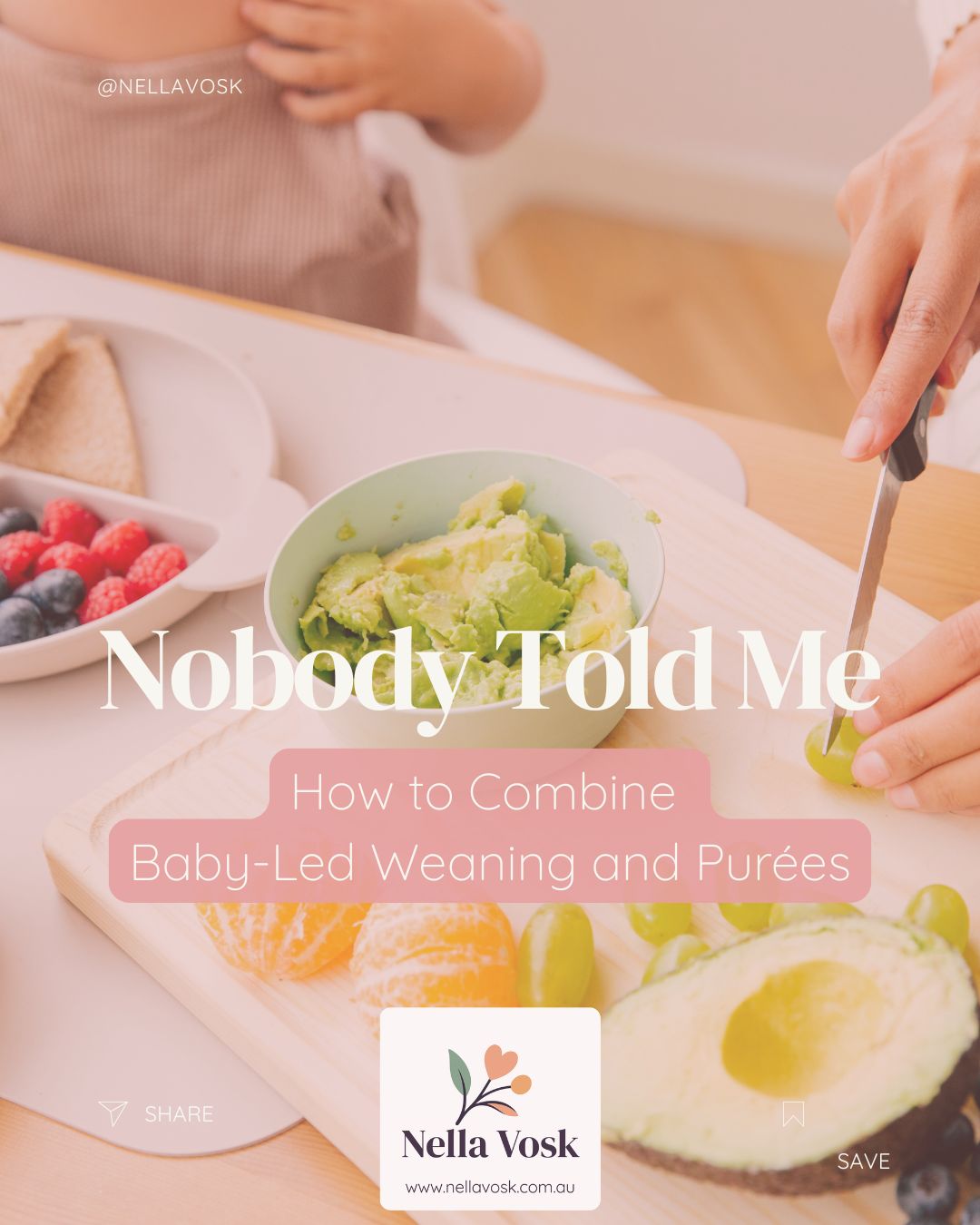
    The conversation around starting solids presents parents with what feels like a fundamental fork in the road: baby-led weaning (BLW) or purées. Online communities are passionate about it in both directions. BLW advocates present finger foods as developmentally superior, promoting self-regulation and fine motor skills. Purée advocates raise choking concerns and emphasise controlled nutritional delivery. Parents enter the solids phase with the impression that they are making a significant, consequential decision between two opposing camps.

    Nobody told me that this is a false binary — that the research does not support the idea that families must choose one approach exclusively, that most families practise some version of both without naming it, and that the evidence on what actually matters for infant feeding outcomes is largely indifferent to which side of this particular debate you’re on.

    What BLW Actually Is — and What It Isn’t

    Baby-led weaning, as originally described by Gill Rapley and Tracey Murkett, is an approach to introducing solids that offers appropriately prepared finger foods from the start of solids introduction, allows the baby to self-feed entirely, and skips the purée phase. The baby controls what goes in their mouth, at what pace, and in what quantity from the beginning.

    This is a description of one end of a spectrum, not a binary category. In practice, BLW as described by its proponents is not practised in pure form by most families who identify as doing BLW. Most ‘BLW families’ use pre-loaded spoons, offer yoghurt and porridge from the start, and include some puréed foods alongside finger foods. These are not departures from BLW that undermine its benefits — they are practical adaptations of the underlying principles.

    The core principle of BLW — that the baby participates actively in eating, controls their own intake, and is given appropriate foods rather than thin homogeneous purées from a spoon wielded by an adult — is compatible with a significant amount of spoon-feeding, puréed food, and mixed texture offering. The binary framing is the problem, not the underlying approach.

    What the Research Actually Compares

    The research literature on BLW vs purée feeding compares two specific approaches: strict BLW (finger foods only from the start, no spoon feeding) and traditional spoon-feeding (purées introduced first, with finger foods added later). The findings are broadly equivalent on most outcomes that matter — nutritional status, weight gain, iron levels, food variety at twelve months — with some modest advantages associated with BLW on self-regulation and some modest disadvantages on iron intake in very strict implementations.

    What the research does not compare is the mixed approach — which is what most families actually do. The absence of research specifically on mixed approaches does not mean they are inferior; it means they haven’t been formally studied as a category. The practical evidence base for what most families are already doing — offering some finger foods alongside some spoon-fed food from the beginning, using both approaches as the situation calls for — is the day-to-day experience of millions of families producing well-nourished children who develop into competent eaters.

    Is Purée or BLW Better?

    This is the wrong question. The right question is: what feeding approach supports this particular baby, at this developmental stage, in this family’s practical circumstances, to receive adequate nutrition and to develop a positive relationship with food?

    For some families, primarily finger foods from the beginning works well: the baby has good sitting support, the gag reflex is functioning normally, the parents are comfortable with mess and with gagging, and the baby engages enthusiastically with self-feeding. For other families, starting with purées and introducing finger foods progressively over the first weeks of solids is more manageable and produces equally good outcomes. For most families, some version of both simultaneously — purées for some meals or some foods, finger foods for others — is what actually happens.

    None of these approaches is evidence-based superior for a typically developing baby without specific health factors. The research does not support the strong claims made by advocates on either side of this debate. What the research supports is responsive, developmentally appropriate feeding that includes a variety of textures and foods from early in the solids journey.

    How to Combine BLW and Purées Practically

    The combination approach is not a compromise between two methods. It is a responsive feeding approach that uses the right tool for the right situation. Some practical frameworks:

    Start with both simultaneously: from the first solids introduction, offer some finger foods and some puréed or soft foods. This gives the baby experience with both self-feeding mechanics and spoon-fed textures from the beginning. The baby learns to handle both, the parents learn which the baby responds to, and neither approach closes off the other.

    Use purées for nutritional density: some of the most nutritionally important foods for a baby in the first months of solids — iron-fortified cereals, legume purées, nut pastes — are not practical as finger foods. Spoon-feeding these foods while offering finger food versions of other items is a sensible way to ensure iron and energy intake while still supporting self-feeding development.

    Follow the baby’s lead on texture progression: most babies naturally signal readiness for more textured and lumpy foods between seven and nine months. The transition from smooth purées to mashed and lumpy textures to soft finger foods to a full family diet happens progressively, and the baby’s gag reflex, oral motor development, and interest in self-feeding are the most reliable guides to pace. Delaying texture progression past nine to ten months is associated with higher rates of texture aversion later — this is one of the clearest practical findings in the infant feeding research.

    Use a pre-loaded spoon for self-feeding of purées: loading a spoon with yoghurt or purée and handing it to the baby to bring to their own mouth bridges BLW and purée feeding. The baby is self-feeding — controlling the spoon, the pace, the direction — but the food is puréed. This is not a compromise. It is developmentally appropriate self-feeding with a different food texture.

    Do not extend the purée phase past developmental readiness: if a baby is showing clear readiness signals for more complex textures — picking up food, mouthing objects, watching others eat with interest — continuing to offer only smooth purées delays the sensory experience that supports texture acceptance. The common practical error on the purée side is continuing thin purées for too long; the common practical error on the BLW side is insufficient attention to iron-rich foods in the early months.

    The Choking Question

    The most frequently cited concern about BLW is choking risk. This concern is addressed in detail in NTM-3-03: Nobody Told Me That Gagging and Choking Are Different. The short version: research comparing choking incidence between BLW and purée-fed babies does not find higher rates of actual choking in BLW. Gagging rates are higher in BLW — because babies are managing more varied textures — but gagging is a protective reflex, not choking, and the two must not be confused.

    The practical safety requirement is food preparation: food must be prepared in shapes and textures that cannot fully occlude the airway. Round foods cut in half, hard foods cooked soft, foods with skin removed. These precautions apply regardless of whether a family is doing BLW, purées, or a combination. Every parent starting solids should understand infant first aid for choking before they begin.

    What Actually Matters

    The evidence on what produces good long-term eating outcomes in children is reasonably consistent. It points to several factors that are entirely compatible with both BLW and purée approaches, and are far more important than which side of this debate a family is on:

    Texture progression: introducing increasingly complex textures before nine to ten months, and not extending the smooth purée phase past the point where the baby is ready for more.

    Food variety: exposing babies to a wide range of flavours, colours, and food categories from early in the solids journey. The sensory foundation for food acceptance is laid in the first months of solids.

    Iron-rich foods: iron is the most common nutritional gap in the transition to solids. Whether through puréed iron-fortified cereal, red meat purée, or soft finger food pieces of well-cooked meat and lentils, iron-rich foods need to feature prominently from the start of solids.

    Allergen introduction: current Australian guidelines recommend introducing common allergens (egg, peanut, dairy, wheat, tree nuts, soy, fish, sesame) between four and six months for babies with eczema or family history of allergy, and by six months for all babies. This recommendation is independent of feeding method and can be implemented through either purées or finger foods.

    The MunchyTime feeding set — suction plate, silicone spoon, fork, and bib — supports both approaches. The divided plate keeps foods separated for babies who find mixed textures on one plate overwhelming. The pre-loadable spoon supports self-feeding of puréeds. The suction base allows the baby to push against the plate while scooping without sending it across the room. It’s a system designed for the reality of how most families actually feed, not the ideological binary.

    Related Reading

    Nobody Told Me That Gagging and Choking Are Different

    Nobody Told Me the Bowl Mattered This Much

    First Foods for Eczema Babies: Safe Introduction Guide

    Allergen Introduction for Eczema Babies — ASCIA Guidelines

    Baby Feeding & Solids Support — Nella Vosk


    ABOUT THE AUTHOR
    Kelly Northey is a Certified Postpartum Nutrition Professional (CPPNP) and founder of Nella Vosk. She has spent fourteen years working with Australian families navigating the full arc of feeding — from breastfeeding and first foods through toddler mealtimes and the anxiety that so often surrounds them. The MunchyTime range exists because mealtimes should be low-stakes, not a battleground.
    Learn more about Kelly.


    Also in Nobody Told Me: Your Toddler at the Table

    Nobody Told Me That the TV I Left on During Dinner Was Making Him Less Likely to Eat
    Nobody Told Me That the TV I Left on During Dinner Was Making Him Less Likely to Eat

    Read More
    Nobody Told Me That Giving My Son the Same Low-Fat Diet I Ate Was Actually Working Against Him
    Nobody Told Me That Giving My Son the Same Low-Fat Diet I Ate Was Actually Working Against Him

    Read More
    Nobody Told Me That My Stress About What He Ate Was Showing Up on His Plate
    Nobody Told Me That My Stress About What He Ate Was Showing Up on His Plate

    Read More