• Add description, images, menus and links to your mega menu

  • A column with no settings can be used as a spacer

  • Link to your collections, sales and even external links

  • Add up to five columns

  • da

  • A column with no settings can be used as a spacer

  • Link to your collections, sales and even external links

  • Add up to five columns

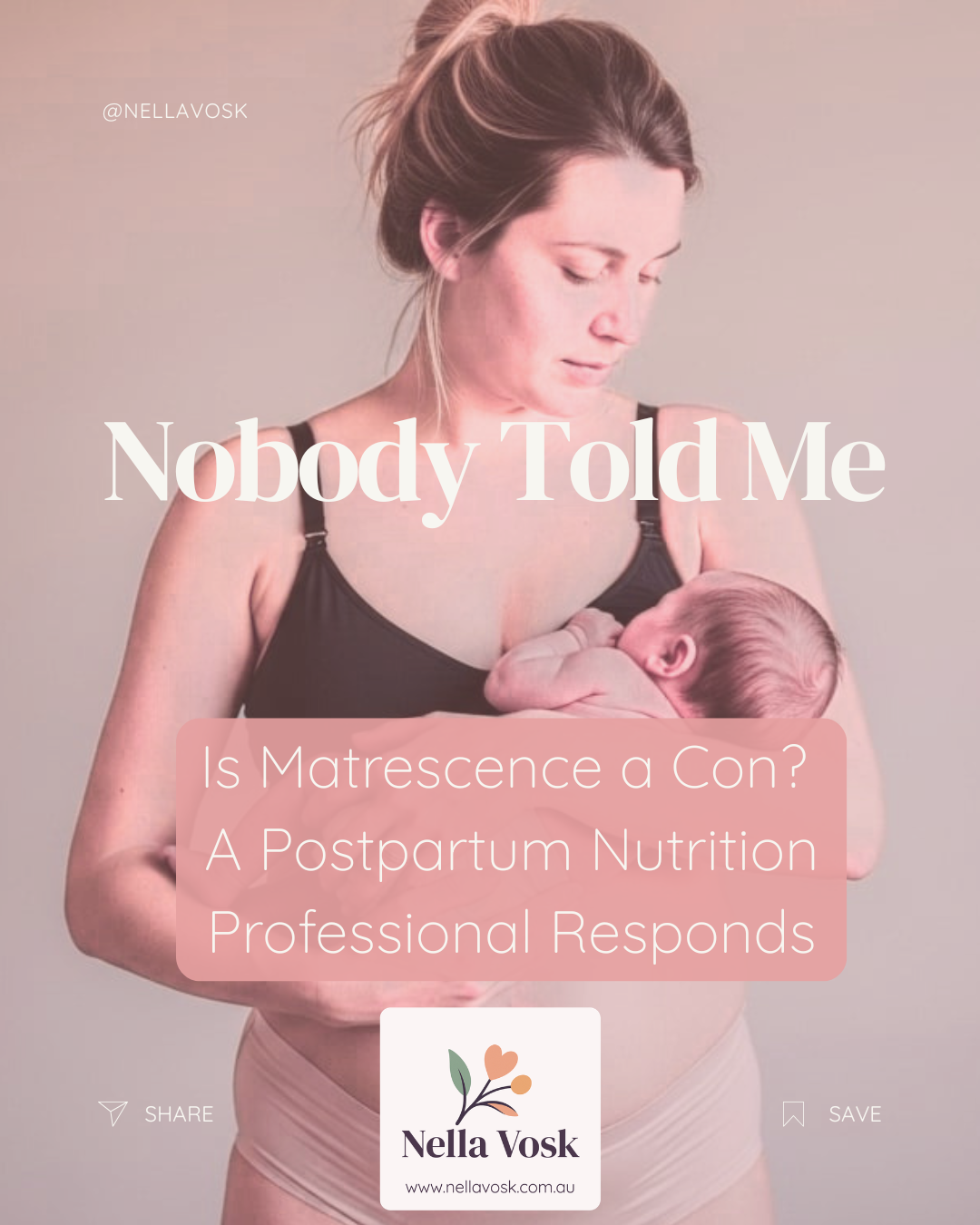
  • Is Matrescence a Con? A Postpartum Nutrition Professional Responds

    Founder of Nella Vosk • 14+ years supporting families across motherhood, feeding, and early childhood wellbeing

    Is Matrescence a Con? A Postpartum Nutrition Professional Responds

    This post is part of the Nella Vosk Nobody Told Me series — on the things mothers consistently aren’t told, and why that matters.


    I read the Spectator Australia piece this week. The one calling matrescence a con.

    And honestly, parts of it are fair.

    The piece is right that a wellness industry has grown up around this word and is charging vulnerable mothers significant sums of money for what often amounts to little more than repackaged positivity. An AU$6,000 coaching certification. An £89 monthly Zoom support group. A festival with sessions called ‘Invite Your Rage for Tea.’

    If you are a depleted new mother trying to work out why you don’t feel like yourself, and someone is charging you AU$6,000 to tell you that you’re going through a normal biological transition, that is a reasonable target for criticism.

    But here is where the piece loses me.

    It dismisses the word because of the industry that has commercialised it. Those are two different things. And conflating them does a disservice to the mothers the piece is ostensibly trying to protect.

    What matrescence actually is

    Matrescence is not a wellness industry invention. It was coined in 1973 by anthropologist Dana Raphael to describe the profound physical, neurological, hormonal, and psychological transformation a woman undergoes when she becomes a mother.

    The science behind it is real and documented. Brain imaging studies show that pregnancy causes measurable, lasting changes to grey matter in regions associated with social cognition and threat processing. The hormonal shift after birth, from peak progesterone and oestrogen to the cascade that initiates lactation, is one of the most rapid hormonal changes a human body can experience outside surgical menopause. And the nutritional depletion that accompanies pregnancy and birth is a physiological reality that can persist for years if it is not actively addressed.

    None of this requires an AU$6,000 coaching program to be true. It was true before the first matrescence coaching certification existed. It will be true after this particular wellness cycle passes.

    The real problem the piece is circling without naming

    The reason the matrescence coaching industry exists and is apparently thriving is the same reason I have spent 14 years working with postpartum families and hearing the same thing over and over again.

    Nobody told me.

    Nobody told them at their prenatal class that their body would be nutritionally depleted after birth. Nobody told them at their six-week check that low milk supply is often a depletion problem, not a personal failure. Nobody told them that the fog and the flatness and the sense of not recognising themselves had a biological basis. Nobody told them that what they ate in those early weeks could change how they felt in those early months.

    The conventional medical system consistently fails to give women this information at the moments when they most need it. That failure creates a vacuum. Wellness entrepreneurs fill it. Some fill it thoughtfully. Some fill it exploitatively. The Spectator piece is right to call out the second group.

    But the answer to an information vacuum is not to dismiss the information. It is to put the right information where mothers can actually find it.

    And it is not just the coaching programs. The commercial response to the matrescence conversation more broadly has gone in one of two directions. Either monetise the vulnerability at a premium, or reframe it as something to perform your way through. You are strong. You are an endurance athlete. Motherhood is the hardest sport and you are winning it.

    Neither of those is the same as actually meeting a mother where she is. A depleted body does not need a higher bar to clear. It needs nourishment. Those are completely different responses to the same reality.

    What I do about it

    I am a Certified Postpartum Nutrition Professional. I did not charge the mothers I worked with $6,000 to explain what was happening to their bodies. I charged them for products formulated specifically around what the postpartum body actually needs, and I put the clinical reasoning behind every ingredient decision on the internet for free.

    I wrote about matrescence last week because it has a name and mothers deserve to know it. Not so they’ll buy something. So they’ll stop thinking something is wrong with them.

    The Spectator piece ends with this recommendation: buy the snot sucker instead. It’s only £8.99.

    She’s not wrong that the snot sucker is useful. But the snot sucker doesn’t explain why you still feel like yourself but not quite at four months postpartum. The snot sucker doesn’t help you understand that your body is rebuilding from a significant nutritional deficit. The snot sucker doesn’t give you language for the experience of becoming someone new while grieving who you were.

    Those things are not worth $6,000. But they are worth knowing.

    If you want to understand what is actually happening in your body during the postpartum period, and what evidence-informed nutrition can do about it, that’s what I write about. It’s free. It’s based on 14 years of clinical work. And nobody charged me $6,000 to learn it.

    Read: What Is Matrescence? The Science Behind Why You Don’t Feel Like Yourself

    Kelly x


    About Kelly Northey

    Kelly Northey is a Certified Postpartum Nutrition Professional and founder of Nella Vosk, an Australian maternal and family wellness brand. She created the Nourish Mama range after her own postpartum experience and 14+ years of working with breastfeeding and postpartum families.
    Kelly writes about postpartum nutrition, breastfeeding support, and the things the conventional system consistently fails to tell mothers.