
• Add description, images, menus and links to your mega menu

  • A column with no settings can be used as a spacer

  • Link to your collections, sales and even external links

  • Add up to five columns

  • da

  • A column with no settings can be used as a spacer

  • Link to your collections, sales and even external links

  • Add up to five columns

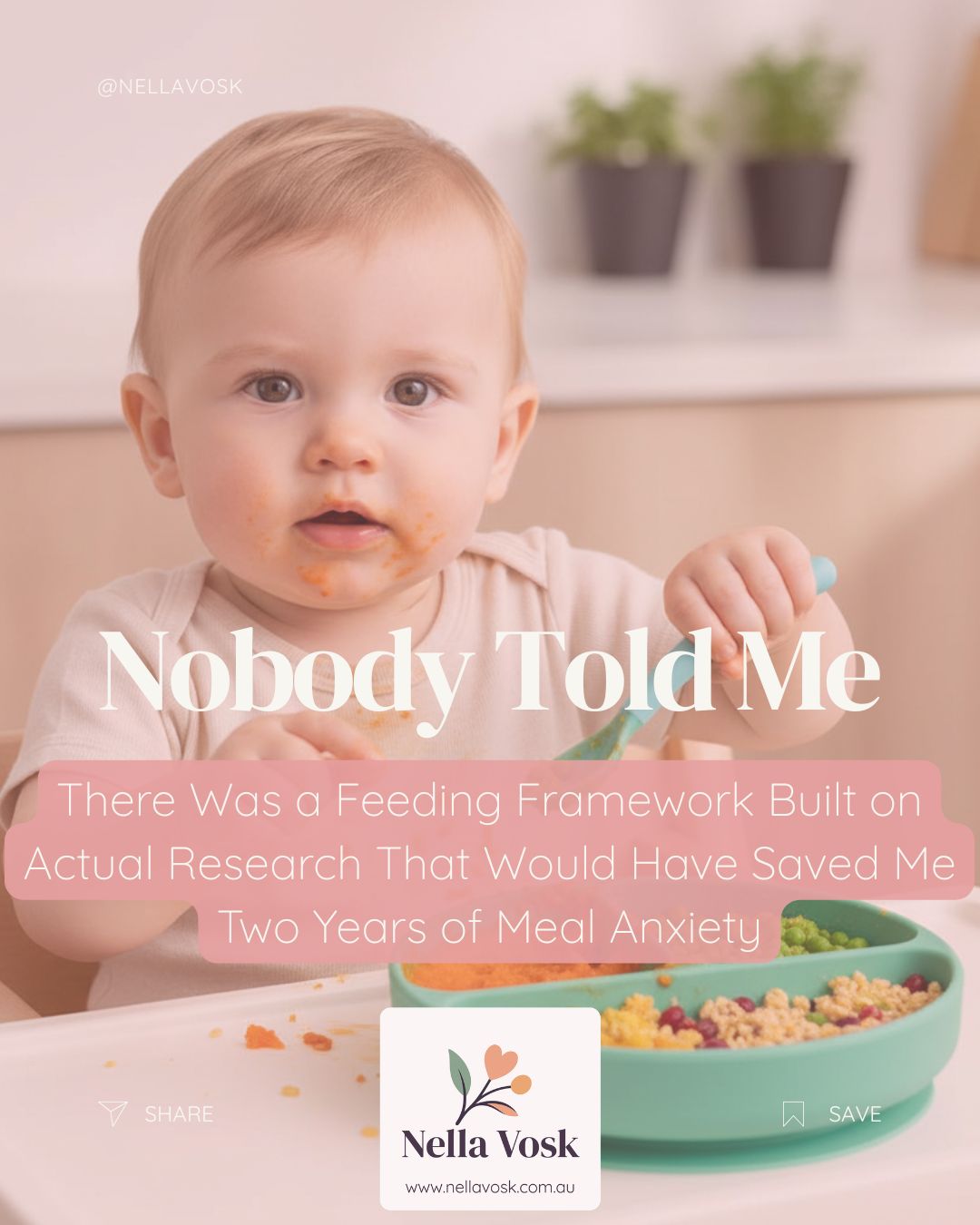
  • Nobody Told Me There Was a Feeding Framework Built on Actual Research That Would Have Saved Me Two Years of Meal Anxiety

    Founder of Nella Vosk • 14+ years supporting families across motherhood, feeding, and early childhood wellbeing

    Nobody Told Me There Was a Feeding Framework Built on Actual Research That Would Have Saved Me Two Years of Meal Anxiety

    This article is part of Nella Vosk’s Nobody Told Me series — a growing collection of posts written for the parent who has been trying everything and still feels like they’re failing their child. Every post in this series starts from a moment a parent wasn’t given information they needed, and works back through what the evidence actually says. You can find the full series at nellavosk.com.au/pages/nobody-told-me.


    Nobody told me there was a feeding framework built on actual research that would have saved me two years of meal anxiety.

    I spent those two years doing what most parents do: bribing, negotiating, hiding vegetables, celebrating every bite like a personal triumph, and quietly spiralling about whether my daughter was getting enough nutrition. I read articles that contradicted each other. I tried ‘one bite’ rules and star charts and the approach where you just put food on the plate and say nothing (which lasted approximately four dinners before I broke). Nothing worked consistently, and nothing changed the fundamental tension that had taken hold of every mealtime in our house.

    What nobody had told me was that the approach I was looking for had been developed, researched, and published decades ago. That there was a framework with a name, a substantial evidence base, and a clear rationale for why it works. That the reason nothing I was doing consistently helped was that I was fundamentally confused about whose job was whose at the table.

    The framework is called the Division of Responsibility in Feeding. The researcher who developed it is Ellyn Satter. And the reason it works is deceptively simple.

    What Is the Division of Responsibility in Feeding?

    Ellyn Satter is a dietitian and family therapist who spent decades working clinically with children with feeding difficulties before developing the framework that now carries her name. The Division of Responsibility — abbreviated DOR or sDOR (Satter Division of Responsibility) — is built on a single foundational insight: that feeding difficulties almost always arise from a confusion about who is responsible for what at the table.

    The parent’s responsibilities: what food is served, when meals and snacks happen, and where eating takes place. The parent chooses the menu. The parent sets the schedule. The parent determines the environment — table, chairs, no screens, relatively calm. Within these decisions, the parent has full authority.

    The child’s responsibilities: whether to eat any given food, and how much. These decisions belong entirely to the child. The parent’s role ends at the edge of the plate.

    That’s the framework. It is not complicated. What makes it difficult is that it requires parents to genuinely relinquish control over the part they have the strongest instinct to manage — whether their child eats — while taking consistent, non-negotiable ownership of the parts they have often been inconsistent about: what is offered, when, and in what environment.

    Why Division of Responsibility Eating Works

    The research supporting DOR is substantial and consistent across several decades. Studies show that children raised in DOR-aligned feeding environments develop greater food variety over time, healthier self-regulation of intake (eating when hungry, stopping when full), more positive relationships with food, and lower rates of both restrictive eating and overeating in later childhood and adolescence.

    The mechanism is not mysterious. Children are born with intact hunger and satiety signals — they know when they’re hungry and when they’ve had enough. These signals are reliable and well-calibrated in the absence of interference. Pressure to eat overrides them: a child who is required to finish their plate learns to eat past fullness. A child who is rewarded for eating learns that food is a performance rather than a response to hunger. A child whose plate is monitored and commented on learns that eating is emotionally significant in a way that creates anxiety rather than comfort.

    The DOR removes all of this interference. The child eats what they want from what is offered. Their hunger signals remain intact. Their relationship with the food on the table is neutral, because the parent’s emotional investment in whether it gets eaten has been deliberately removed from the equation.

    What consistently surprises parents who implement DOR faithfully is how quickly the mealtime tension drops. Not because the child suddenly starts eating broccoli, but because the battle has been removed. There is nothing to fight about. The food is there. The child decides. The mealtime ends. Over time — weeks, months, and with persistent foods sometimes years — exposure accumulates and acceptance often follows.

    The Common Misreading: What DOR Is Not

    The most frequent misapplication of DOR is treating the child’s side of the framework as permissive. Parents read ‘the child decides whether to eat’ and conclude that DOR means letting the child eat whatever they want whenever they want, or providing alternative meals when the served food is refused.

    This is the opposite of DOR. The parent’s authority over what is served, when, and where is non-negotiable within the framework. A DOR table does not feature a separate toddler meal alongside the family dinner. It does not include a standing offer of toast as a backup. It does not adjust the menu based on the child’s preferences at the last minute. The parent serves a meal. The child eats from it or doesn’t. The meal ends at the same time for everyone.

    This structural consistency is part of how DOR works. A child who knows that what is on the table is what is available — and that this will be true at every meal — is a child who is eventually motivated by hunger to engage with the food in front of them. A child who knows that refusing the offered food will produce an alternative has no such motivation.

    The Family Meal as the DOR Vehicle

    DOR is most effectively implemented through shared family meals — everyone eating the same food at the same time in the same place. This is not just logistically convenient; it is a core mechanism of how food acceptance develops in children.

    Children learn to eat primarily through observation. A toddler who regularly sees adults and older children eating a food without drama, without comment, and without it being presented as a challenge or a treat is a toddler whose nervous system is gradually registering that food as safe and normal. This process is slow and cannot be rushed. But it is reliable, and it does not require any active intervention from the parent beyond the consistent presence of the food on the table.

    Shared family meals also make the DOR easier to implement because the parent is eating the same food and is less likely to monitor the child’s plate when focused on their own meal and the broader mealtime experience. The no-comment rule — not remarking on what the child eats or doesn’t eat in either direction — is easier to maintain when the parent has their own food to attend to.

    What to Do When the Child Eats Nothing

    The most anxiety-provoking moment in DOR implementation is the meal where the child eats nothing at all. This will happen. It is not a sign that DOR is failing.

    Satter’s guidance on this is consistent: the meal ends, the child does not eat again until the next scheduled meal or snack, and the next meal or snack happens on schedule regardless of what was or wasn’t eaten at the previous one. A child who skips dinner will be hungry at breakfast. A child who experiences hunger and then finds food available at the next reliable mealtime is learning, at a bodily level, that the feeding relationship is trustworthy — that food comes, that hunger ends, that the parent provides.

    This is much harder for the parent than for the child. The instinct to ensure the child has eaten something before bed is powerful and entirely understandable. Acting on it by offering alternatives undermines the structure that makes DOR work. The discomfort is the parent’s, not the child’s — a well-nourished child who misses one meal will not be harmed. The pattern that emerges when alternatives are consistently offered will be.

    Implementing DOR in Practice

    Start with structure: Three meals and two to three planned snacks per day, at consistent times. No grazing between scheduled eating occasions. Grazing — continuous small amounts throughout the day — blunts hunger signals and is one of the most common reasons children arrive at meals unmotivated to eat. Structured mealtimes create the appetite that makes eating likely.

    Serve one family meal: with one component the child is reliably willing to eat alongside the other food. This is not the same as making a separate toddler meal — it is including bread, rice, or a fruit the child tolerates alongside whatever is being served. The child always has something they can eat. They do not have to eat any of it.

    Remove the commentary: No praise for eating. No disappointment at refusal. No ‘just try one bite.’ No ‘you need to eat your protein.’ The food is on the table. It is available. What the child does with it is their business. This is the hardest single behaviour change for most parents and the one that makes the most difference to mealtime atmosphere.

    Stay at the table: Eat your own food. Have a conversation. Make the mealtime experience pleasant for the people in it. Children who associate mealtimes with pleasant, calm family connection are more willing participants in the long run than children for whom meals are stressful, monitored experiences.

    The right equipment can support the DOR environment too — tools that give a toddler physical independence at the table, like a suction plate they can’t tip over, reduce the mess variable and make it easier to let the child manage their own eating without constant adult intervention.

    What About Nutrition in the Meantime?

    DOR is not a nutritional free-for-all. The parent’s responsibility to serve a variety of foods — across food groups, across flavours and textures, including foods the child has previously rejected — is the mechanism through which nutritional adequacy is maintained and food variety eventually expands. The child’s refusal of any given food on any given day does not remove it from the table. It comes back. Again and again. Without comment. We covered why this repeated exposure is the mechanism of food acceptance, and the research on how many exposures it actually takes, in this blog article here.

    If there is a specific concern about nutritional adequacy — poor weight gain, very restricted diet affecting growth, signs of iron deficiency — a GP or paediatric dietitian is the right resource. For most toddlers with typical fussy eating, DOR implemented consistently provides adequate nutrition through variety across the week even when individual meals look sparse.

    Related Reading

    Nobody Told Me That Refusing Food Was My Toddler’s Job

    Baby Feeding & Solids Support — Nella Vosk

    First Foods for Eczema Babies: Safe Introduction Guide

    MunchyTime Baby-Led Weaning Feeding Set


    ABOUT THE AUTHOR
    Kelly Northey is a Certified Postpartum Nutrition Professional (CPPNP) and founder of Nella Vosk. She has spent fourteen years working with Australian families navigating the full arc of feeding — from breastfeeding and first foods through toddler mealtimes and the anxiety that so often surrounds them.
    The MunchyTime range exists because mealtimes should be low-stakes, not a battleground.
    Learn more about Kelly.


    Also in Nobody Told Me: Your Toddler at the Table

    Nobody Told Me That the TV I Left on During Dinner Was Making Him Less Likely to Eat
    Nobody Told Me That the TV I Left on During Dinner Was Making Him Less Likely to Eat

    Read More
    Nobody Told Me I Had to Choose
    Nobody Told Me I Had to Choose

    Read More
    Nobody Told Me That Giving My Son the Same Low-Fat Diet I Ate Was Actually Working Against Him
    Nobody Told Me That Giving My Son the Same Low-Fat Diet I Ate Was Actually Working Against Him

    Read More