
• Add description, images, menus and links to your mega menu

  • A column with no settings can be used as a spacer

  • Link to your collections, sales and even external links

  • Add up to five columns

  • da

  • A column with no settings can be used as a spacer

  • Link to your collections, sales and even external links

  • Add up to five columns

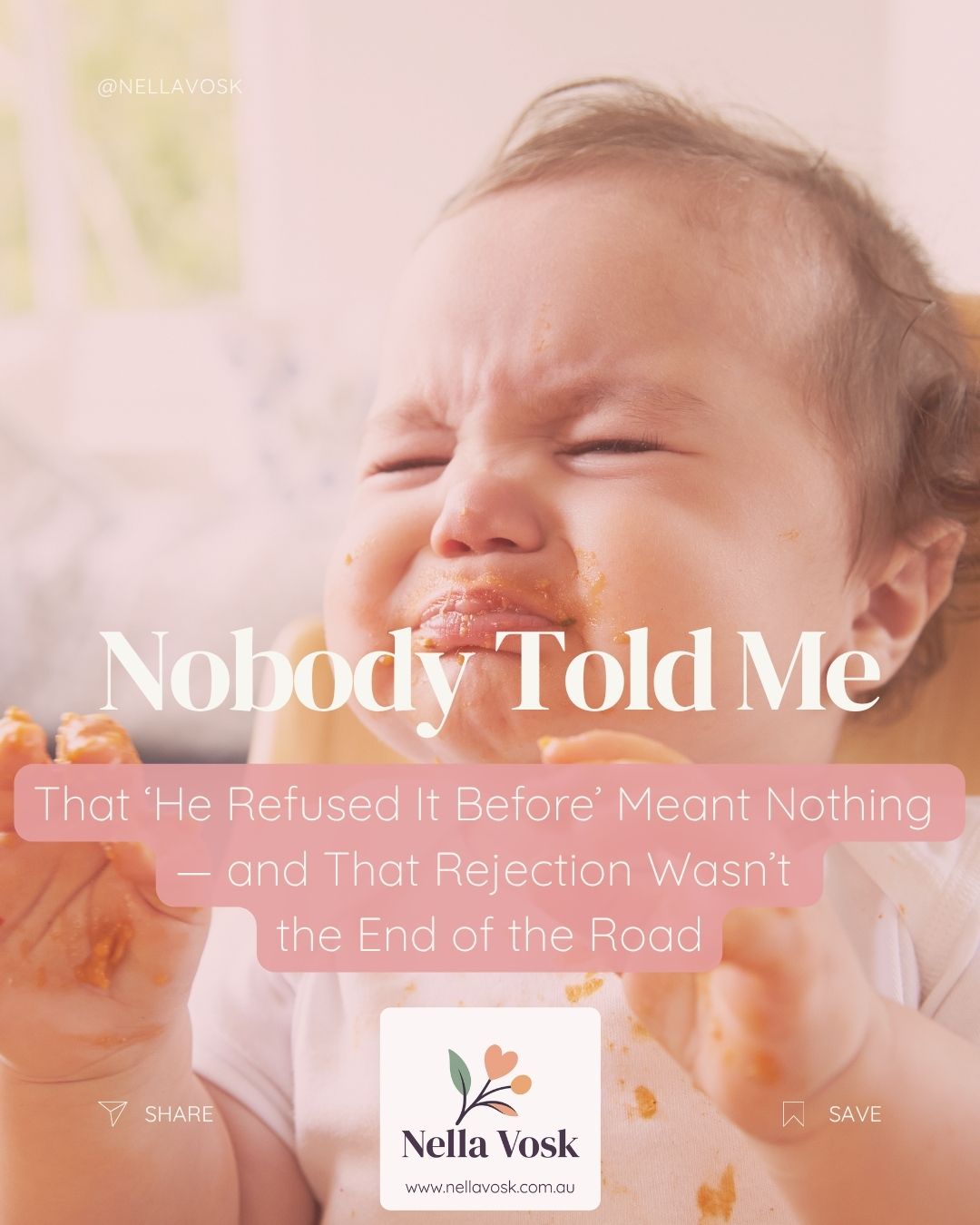
  • Nobody Told Me That ‘He Refused It Before’ Meant Nothing — and That Rejection Wasn’t the End of the Road

    Founder of Nella Vosk • 14+ years supporting families across motherhood, feeding, and early childhood wellbeing

    Nobody Told Me That ‘He Refused It Before’ Meant Nothing — and That Rejection Wasn’t the End of the Road

    This article is part of the Nella Vosk Baby Feeding & Solids Support Guide — evidence-based guidance for Australian families navigating the transition to solids, fussy eating, and toddler mealtimes.

    This article is part of Nella Vosk’s Nobody Told Me series — a growing collection of posts written for the parent who has been trying everything and still feels like they’re failing their child. Every post in this series starts from a moment a parent wasn’t given information they needed, and works back through what the evidence actually says. You can find the full series at nellavosk.com.au/pages/nobody-told-me.


    Nobody told me that ‘he refused it before’ meant nothing — and that rejection wasn’t the end of the road.

    I stopped offering broccoli after four dinners in a row where it came back untouched. I stopped offering avocado after two sessions where it was pushed to the edge of the plate with visible distaste. I stopped offering salmon after it was thrown on the floor twice. My mental model of my son’s food preferences was being constructed entirely from first and second impressions, and I was drawing permanent conclusions from what was, in the research, introductory data.

    What nobody had told me was that the number of times a child needs to encounter a food before accepting it is not two, or four, or even ten. The research on food neophobia — the hardwired wariness of new or unfamiliar foods that peaks in toddlerhood — consistently finds that acceptance typically requires between fifteen and twenty exposures, and frequently more. And critically: many of those exposures don’t need to involve eating at all.

    I had been stopping at the point where the evidence says you are only just beginning.

    What the Research Actually Says About Food Exposure

    The science behind repeated food exposure and acceptance in children has been building since the 1980s, with landmark work by developmental psychologist Leann Birch establishing the foundational principle: toddlers and young children learn to accept foods through repeated, low-pressure exposure, not through pressure to eat or clever disguising of rejected foods.

    The number most commonly cited in the research — fifteen to twenty exposures — comes from studies examining how many times a child needs to encounter an unfamiliar food before their ratings of that food begin to shift from negative to neutral or positive. Subsequent research has refined and replicated these findings, with some studies suggesting that for particularly neophobic children or particularly challenging foods, the exposure count can be considerably higher.

    What the research is equally clear on is the quality of those exposures. The exposure needs to be low-pressure — the food presented without comment, expectation, or any signal from the parent that eating is required or hoped for. High-pressure exposures — where the child can sense that the parent is invested in whether they eat the food — do not contribute to acceptance in the same way. They may actually increase aversion, because the child begins to associate the food with the emotional tension of the mealtime rather than with neutral or positive sensory experience.

    What Counts as an Exposure

    This is the piece of the research that most parents find genuinely surprising and, once understood, genuinely relieving: an exposure does not require eating.

    The exposure model in food neophobia research recognises a hierarchy of encounters, each of which contributes to the gradual process by which a food moves from ‘unfamiliar and threatening’ to ‘familiar and safe’ in the child’s nervous system:

    Visual exposure: the food is on the plate, or on the table, or being eaten by someone else. The child sees it without being required to interact with it. This is a genuine exposure. A child who has seen broccoli on the table at twenty family meals has had twenty visual exposures to broccoli, even if they have never put it in their mouth.

    Proximity and handling: the child picks up the food, pokes it, moves it around the plate, smells it. They do not eat it. This is a more advanced exposure than visual-only and is particularly valuable for children with texture sensitivity. A child who consistently handles a food without distress is already partway down the acceptance pathway.

    Oral exploration without eating: the child puts the food in their mouth, mouths it, and spits it out. For many parents this feels like failure. In the exposure model, it is not. The child has received oral sensory information about the food — its texture, temperature, taste — and has not experienced a negative consequence. This is a significant exposure.

    Tasting: the child swallows a small amount, possibly with a grimace, possibly with apparent indifference. This is an exposure with the highest information value — the child’s system has registered the taste and tolerated it. It does not need to be enjoyed or repeated within the meal to count.

    Eating: the child eats some amount of the food willingly. This is the outcome parents are aiming for, but it is not the only step that counts toward getting there. Every step above contributes to making this step more likely over time.

    The practical implication is that a toddler who consistently rejects a food by pushing it to the edge of the plate is still being exposed to it. A child who occasionally picks it up and puts it down is making meaningful progress. Neither of these look like success from the outside — but both are moving in the right direction if the parent keeps offering the food without pressure and without comment.

    Why Parents Stop Too Early

    The gap between what the research shows (fifteen to twenty-plus exposures) and what most parents do (stop offering after three to five rejections) is not a failure of intention. It is a predictable response to the emotional experience of repeated rejection and to the absence of any information that rejection is normal, temporary, and will resolve with time.

    When a child pushes away a food they were cheerfully eating three weeks ago, the parent’s natural interpretation is that something has changed and that continuing to offer the food is futile. When a child refuses a new food twice in a row, the natural interpretation is that this child doesn’t like that food. Both interpretations feel rational. Both lead to the same outcome: the food disappears from the table, the diet narrows, and the window for easy exposure closes.

    What’s missing from the parent’s mental model is the timeline. The research says acceptance is a process measured in months and dozens of encounters, not days and handfuls of meals. A parent who understands that timeline can make very different decisions about the same behaviours.

    The Role of Modelling

    One of the most reliable mechanisms through which food exposure leads to acceptance is modelling: the child observing others eating the food in a normal, matter-of-fact way. This is why shared family meals — where everyone eats the same food at the same table — are such a powerful vehicle for food acceptance. The child is receiving visual exposure at every meal, and the social context of that exposure (adults eating the food, appearing to enjoy it, without comment or drama) is the most powerful normalisation signal available.

    Research specifically examining the modelling effect in toddlers finds that watching an adult or older child eat a food with apparent enjoyment shifts the toddler’s willingness to try that food measurably more than encouragement or reward. The child’s nervous system is looking for social safety cues, and the most credible safety cue is another person eating the food without dying.

    This is one reason that the ‘no comment’ principle in the Division of Responsibility framework — covered in an earlier post in this series — matters so much. A parent who praises the child for eating broccoli has inadvertently signalled that eating broccoli is unusual and praise-worthy. A parent who eats their own broccoli in silence while the child watches has provided the more powerful normalisation: broccoli is just food that people eat.

    The Sensory Dimension

    Food acceptance in young children is not purely about familiarity — it is also about sensory experience. Many toddlers who consistently reject certain foods are not rejecting flavour but texture: smooth foods they liked as pureés become problematic when presented as lumpy or chunky versions; foods with mixed textures (casseroles, stews) are rejected when each component is accepted individually; foods with soft exteriors and firmer interiors produce a startle response that looks like dramatic disgust.

    Understanding the sensory dimension changes how exposure is structured. A child who accepts broccoli when it is very soft and well-cooked but rejects it when it has texture may be at a different point on the exposure ladder for cooked-broccoli than for al-dente-broccoli. These are, from the child’s sensory perspective, different foods. The exposure count for each is separate.

    This is not a reason to only ever serve one version of a food. It is a reason to be thoughtful about preparation and not to conclude that rejection of one presentation means rejection of the food entirely. A child who will eat grated carrot but not carrot sticks has accepted carrot — as grated carrot. Continued exposure to carrot sticks alongside the accepted grated version is how the exposure count builds for the new format.

    Practical Application at the Table

    Keep offering: this is the core principle and the hardest to maintain without the research to back it. A food that was rejected last Tuesday goes back on the plate this Tuesday. It is not referenced. It is not commented on. It appears as food appears — as a normal, available, unremarkable part of the meal.

    Include one safe food at every meal: a food the child reliably eats alongside the foods being exposed. This is not the same as making a separate toddler meal — it is ensuring that the child can eat something if they are hungry, which removes starvation anxiety from the table and makes the parent’s genuine non-investment in whether the exposed food is eaten easier to maintain.

    Let handling count: a child who touches a food, smells it, moves it around the plate, or puts it in their mouth and spits it out is doing exposure work. Acknowledge nothing. React to nothing. This counts.

    Keep serving sizes small: a large serving of a rejected food on a small plate is overwhelming. A small amount alongside other foods is a different sensory experience. The food is present without dominating. The child can choose to interact with it or not.

    The equipment at the table also matters. A divided suction plate keeps foods separated — important for children who reject foods on the basis of contamination (food touching food) as well as for those who find a single plate of mixed items overwhelming. Giving a child visual and physical control over their plate space lowers the sensory stakes of a new food being present.

    Don’t track out loud: parents sometimes make the mistake of noting progress to the child (‘last week you ate two bites’) or expressing relief when a food is eaten after many rejections. These responses signal that the eating was remarkable, which adds pressure to future encounters. The goal is for accepted foods to become unremarkable.

    When to Seek Support

    The exposure model works for the typical range of toddler food neophobia — the child who is picky, slow to accept new foods, and goes through periods of preferring a limited repertoire. It is less reliable for children whose food refusal is more extreme: genuinely refusing to eat anything except a very small number of specific foods, losing weight or not gaining appropriately, showing extreme distress at the sight of new foods or at the sensory experience of being near them, or having gagging responses to textures that go beyond the normal range.

    These presentations may indicate a sensory-based feeding difficulty that benefits from assessment by an occupational therapist or a paediatric feeding specialist. The exposure principles still apply, but the pace, the structure, and the support needed are different. A GP referral is the appropriate starting point.

    For the majority of families sitting at the table every evening wondering why the broccoli is back on the floor again: the exposure count is almost certainly not high enough yet. Keep going. The research says this resolves. It just takes longer than anyone told you.

    Related Reading

    Nobody Told Me That Refusing Food Was My Toddler’s Job

    Nobody Told Me There Was a Feeding Framework Built on Actual Research

    Baby Feeding & Solids Support — Nella Vosk

    First Foods for Eczema Babies: Safe Introduction Guide


    ABOUT THE AUTHOR
    Kelly Northey is a Certified Postpartum Nutrition Professional (CPPNP) and founder of Nella Vosk. She has spent fourteen years working with Australian families navigating the full arc of feeding — from breastfeeding and first foods through toddler mealtimes and the anxiety that so often surrounds them. The MunchyTime range exists because mealtimes should be low-stakes, not a battleground.
    Learn more about Kelly.


    Also in Nobody Told Me: Your Toddler at the Table

    Nobody Told Me That the TV I Left on During Dinner Was Making Him Less Likely to Eat
    Nobody Told Me That the TV I Left on During Dinner Was Making Him Less Likely to Eat

    Read More
    Nobody Told Me I Had to Choose
    Nobody Told Me I Had to Choose

    Read More
    Nobody Told Me That Giving My Son the Same Low-Fat Diet I Ate Was Actually Working Against Him
    Nobody Told Me That Giving My Son the Same Low-Fat Diet I Ate Was Actually Working Against Him

    Read More