• Add description, images, menus and links to your mega menu

  • A column with no settings can be used as a spacer

  • Link to your collections, sales and even external links

  • Add up to five columns

  • da

  • A column with no settings can be used as a spacer

  • Link to your collections, sales and even external links

  • Add up to five columns

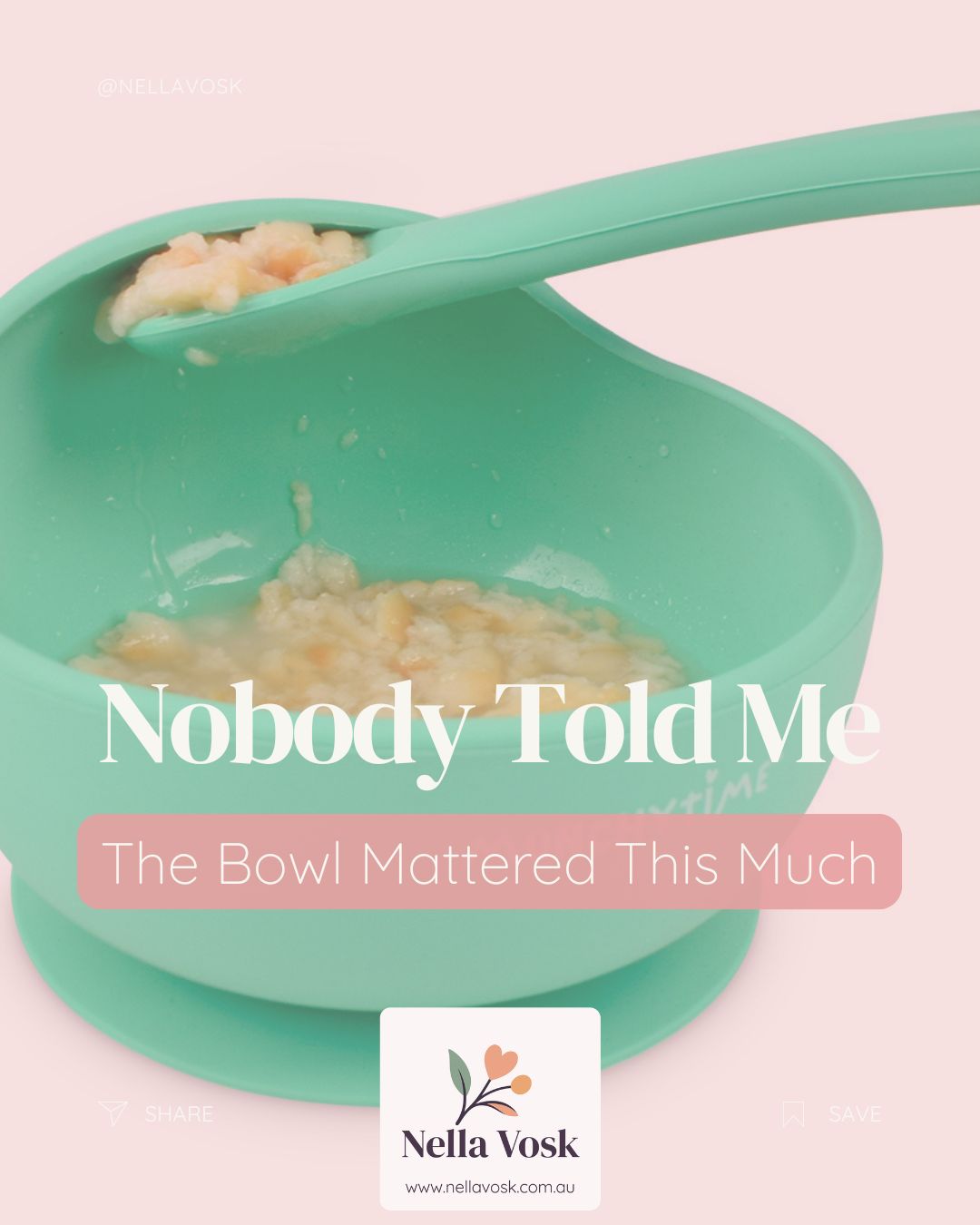
  • Nobody Told Me the Bowl Mattered This Much

    Founder of Nella Vosk • 14+ years supporting families across motherhood, feeding, and early childhood wellbeing

    Nobody Told Me the Bowl Mattered This Much

    This article is part of the Nella Vosk Baby Feeding & Solids Support Guide — evidence-based guidance for Australian families navigating the transition to solids, fussy eating, and toddler mealtimes.

    This article is part of Nella Vosk’s Nobody Told Me series — a growing collection of posts written for the parent who has been trying everything and still feels like they’re failing their child. Every post in this series starts from a moment a parent wasn’t given information they needed, and works back through what the evidence actually says. You can find the full series at nellavosk.com.au/pages/nobody-told-me.


    Nobody told me the bowl mattered this much.

    When my son started solids I was focused on the food — what to introduce, in what order, how much, at what texture. The equipment was an afterthought. A bowl is a bowl. A spoon is a spoon. We had a collection of brightly coloured plastic things from the baby section and I didn’t give them much thought.

    What I didn’t understand until later — when I started looking more carefully at what the research on self-feeding development actually says — was that the physical environment of the mealtime has a measurable effect on how a child engages with food, how quickly they develop self-feeding skills, and how their relationship with mealtimes forms. The bowl is not incidental. The spoon is not incidental. The setup of the table is not incidental. These are variables that can be deliberately managed, and managing them makes a genuine difference.

    Self-Feeding Developmental Milestones: The Timeline

    Self-feeding is a developmental process that unfolds across the first two to three years of life, following a broadly predictable sequence as fine motor skills, oral motor coordination, and cognitive capacity develop together.

    Around 6–7 months: most babies can sit with support and have developed sufficient head and trunk control to engage with food. At this stage, the dominant grasp is palmar — the baby rakes food toward them with the whole hand and brings it to their mouth. Finger foods soft enough to dissolve (banana, well-cooked sweet potato, avocado) are appropriate at this stage. The baby is learning that they can move food from surface to mouth, which is the foundational motor pattern everything else builds on.

    Around 8–9 months: the pincer grasp begins to develop — the ability to pick up smaller objects between thumb and forefinger. This opens up a wider range of finger foods and gives the baby more control over individual pieces. Babies at this stage often prefer finger foods to being spoon-fed, because the palmar and early pincer grip give them something to do with their hands.

    Around 12 months: most children can attempt to use a spoon, though with significant spilling. The wrist rotation required to keep a spoon level while it travels from bowl to mouth is a complex motor skill that takes months to develop. At 12 months, the child understands the concept and is working on the mechanics. Expecting precision is unrealistic. Expecting interest and effort is entirely appropriate.

    Around 15–18 months: spoon use becomes more reliable. Less food lands on the table or the child’s lap with each passing week. Fork use begins to develop around this time for softer foods. The child is increasingly motivated to feed themselves and may resist being spoon-fed by an adult.

    Around 24 months: most toddlers can use a spoon and fork with reasonable reliability. Some spilling continues to be normal and expected — the fine motor refinement required for consistently level spoon transport continues developing into the preschool years.

    Understanding this timeline matters because it sets appropriate expectations at each stage. A twelve-month-old who covers themselves in yoghurt when given a spoon is not being messy — they are learning. A fifteen-month-old who insists on feeding themselves and refuses to be helped is not being difficult — they are exercising the developmental drive toward autonomy that is supposed to be present at this age.

    Why Self-Feeding Independence Matters

    The research on self-feeding goes well beyond the development of motor skills. The act of a child feeding themselves — controlling what goes in their mouth, at what pace, in what quantity — is directly connected to several outcomes that matter to parents managing toddler mealtimes.

    Appetite self-regulation: children who feed themselves are better able to eat to hunger and stop at satiety than children who are spoon-fed by an adult. When an adult controls the spoon, they also control the pace and quantity of what goes in. When the child controls the spoon, their own hunger and fullness signals determine how much they eat. The research on this is consistent: self-feeding from early solids introduction is associated with better long-term appetite regulation.

    Sensory engagement with food: self-feeding involves direct sensory contact with food — the texture, temperature, and appearance are experienced hands-on rather than observed from a distance. This sensory engagement is part of the exposure process we discussed in NTM-3-05. A child who touches and handles food regularly — even when not eating it — is accumulating the sensory familiarity that makes acceptance more likely over time.

    Fine motor development: the repeated practice of grasping, transporting, and releasing food items develops the same fine motor pathways that will later support writing, drawing, and other precision hand skills. Mealtimes are occupational therapy practice disguised as lunch.

    Mealtime engagement and attitude: children who are actively involved in the mechanics of their own eating tend to be more engaged at the table and more positive about mealtimes generally than children who are passively fed. This is not universally true — some children with sensory sensitivities find the messiness of self-feeding distressing — but the broad pattern in the research favours active participation.

    Why the Bowl Actually Matters

    A bowl that moves when a baby pushes against it with a spoon teaches nothing except frustration. A bowl that stays in place allows the child to focus their effort on the coordination of scooping, rather than on chasing the bowl around the table.

    This is the core functional argument for suction-base bowls and plates in early self-feeding: stability removes a variable that would otherwise require adult intervention. If every spoon attempt causes the bowl to skid sideways and the parent has to constantly reach in to hold it still, the child is not independently self-feeding — they are self-feeding with significant adult scaffolding. Removing that scaffolding — by providing a base that doesn’t move — gives the child genuine independence at the table.

    The raised inner rim is the second functional element that is often underappreciated. A bowl with a curved inner edge allows the child to load the spoon by pushing it against the side of the bowl — a technique that is far more accessible to a child with developing wrist control than the technically demanding process of scooping from a flat plate. The curve does some of the work for them, which means more food makes it to the mouth and less frustration at the mealtime.

    How to Get Suction Plates to Stick

    The most common complaint about suction-base feeding equipment is that it doesn’t stay stuck. The suction mechanism requires a non-porous, flat surface and a clean underside to create the vacuum seal. The most reliable surfaces are smooth highchair trays and glass or tile tables. Textured highchair trays, textured place mats, or wooden table surfaces significantly reduce suction effectiveness.

    For best adhesion: ensure both the table surface and the suction base are dry and clean before placement. Press the bowl down firmly and run a finger around the outer edge of the suction base to confirm the seal. Some suction plates have a tab or button that releases the seal — these tend to hold more securely than simple suction bases because the seal cannot be released accidentally by a toddler pushing upward.

    If the suction consistently fails on your table surface, a smooth silicone place mat under the plate creates the non-porous surface needed for suction to work, regardless of the underlying table material.

    Spoons: What Makes a Difference at Each Stage

    Early solids (6–9 months): a short-handled, shallow-bowled spoon that the parent can control easily for initial pureé feeding, alongside a second spoon that the baby can hold and explore independently. Giving the baby a spoon to hold while the parent feeds from another is the standard recommendation for early spoon introduction — it gives the baby a sensory object to mouth and become familiar with while removing it from the transport task they’re not yet developmentally ready to manage.

    Self-feeding transition (9–15 months): a pre-loaded spoon placed in the baby’s hand allows the child to practise the wrist-rotation transport action without needing to manage the scooping step simultaneously. Load the spoon, hand it to the child, let them get it to their mouth. This is the bridge between parent-led feeding and full self-feeding.

    Independent spoon use (15+ months): a spoon with a slightly deeper bowl retains more food during transport, which reduces frustration and increases how much actually reaches the mouth. A slightly weighted handle can help with the controlled deceleration needed to keep the spoon level. Silicone spoon heads are softer against gums and teeth than metal or hard plastic, which matters for children who are still teething.

    The Mess Question

    Self-feeding is messy. This is not a problem to be solved — it is an inherent feature of the developmental process. A toddler learning to use a spoon will spill food. A baby learning to self-feed with their hands will spread food on the table, the tray, their face, their hair, and occasionally the floor.

    The evidence on parental response to mess is consistent with the broader literature on mealtime pressure: parents who react negatively to mess — rushing in to clean up, expressing frustration, limiting self-feeding because of the cleanup required — interrupt the learning process and make mealtimes more stressful than they need to be. A silicone bib with a catch pocket, a mat under the highchair, and the expectation that cleanup is part of the mealtime rather than a sign that something has gone wrong are the practical tools for managing this.

    The MunchyTime feeding set includes the suction plate, silicone spoon and fork, and catch bib in a single kit specifically because these elements work together as a system — the stable plate, the appropriate utensils, and the mess-management layer that makes independent eating possible without the cleanup overhead becoming the reason the parent takes over.

    When Equipment Is Not the Issue

    It’s worth being direct about what equipment does and doesn’t do. A suction plate supports self-feeding by providing stability. A curved-rim bowl supports spoon loading. A well-designed spoon supports transport. None of these change whether a child eats a particular food, how much they eat at a given meal, or whether they go through a phase of refusing everything they previously accepted.

    The equipment reduces the physical barriers to self-feeding so the developmental process can proceed without unnecessary frustration. It does not resolve neophobia, it does not change the exposure timeline, and it does not substitute for the low-pressure, high-consistency mealtime environment that the research on toddler feeding consistently points to.

    What it does is remove one source of difficulty — the mechanics of getting food to the mouth independently — and hand that capacity back to the child at the developmental stage when they are ready to exercise it. That is not a small thing. Giving a toddler genuine independence at the table, even one meal at a time, is part of how they learn that mealtimes are their territory, that their body’s signals matter, and that food is something they engage with on their own terms.

    Related Reading

    Nobody Told Me That Refusing Food Was My Son’s Job

    Nobody Told Me There Was a Feeding Framework Built on Actual Research

    Nobody Told Me That Rejection Wasn’t the End of the Road

    First Foods for Eczema Babies: Safe Introduction Guide

    Baby Feeding & Solids Support — Nella Vosk


    ABOUT THE AUTHOR
    Kelly Northey is a Certified Postpartum Nutrition Professional (CPPNP) and founder of Nella Vosk. She has spent fourteen years working with Australian families navigating the full arc of feeding — from breastfeeding and first foods through toddler mealtimes and the anxiety that so often surrounds them. The MunchyTime range exists because mealtimes should be low-stakes, not a battleground.
    Learn more about Kelly.


    Also in Nobody Told Me: Your Toddler at the Table

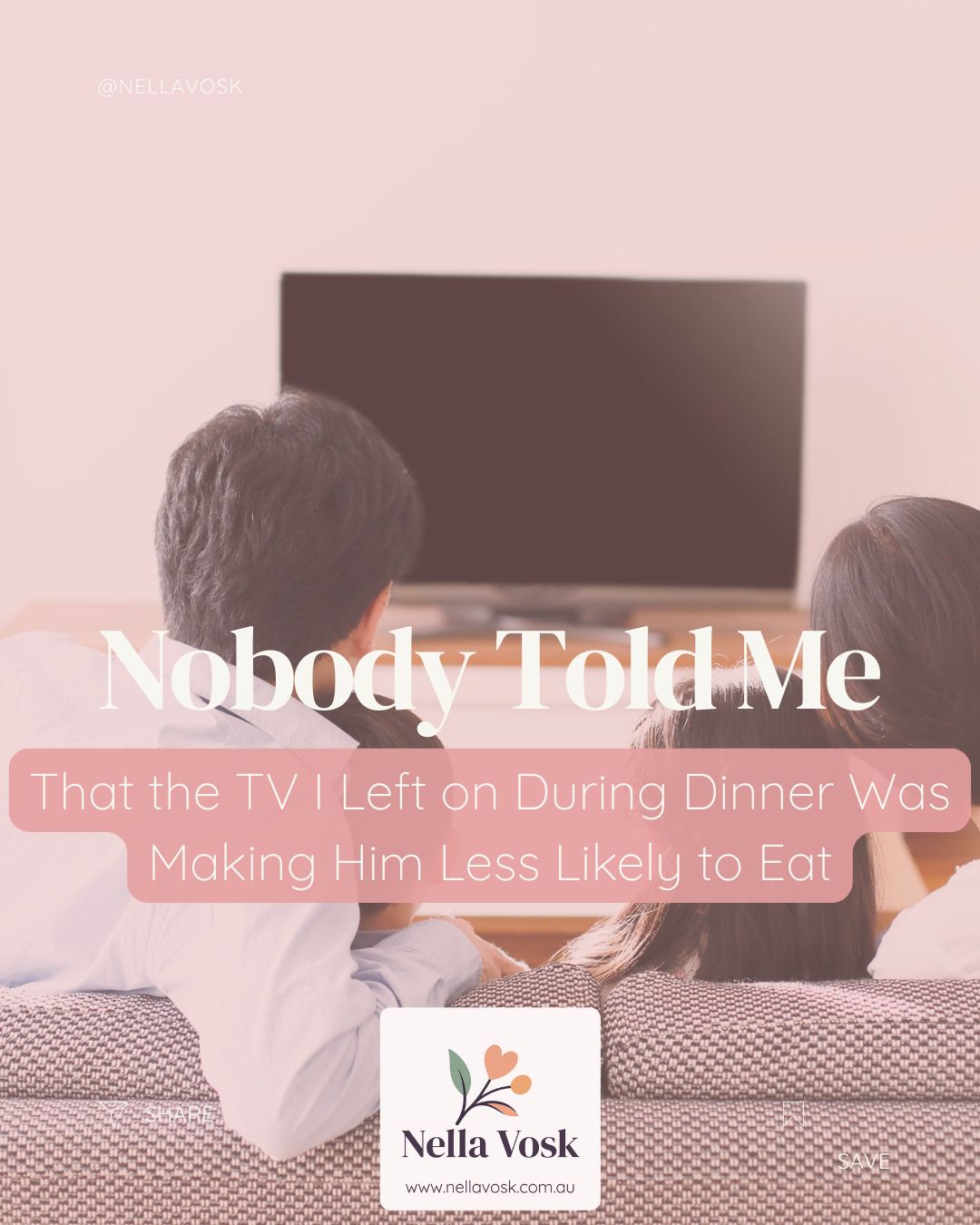
    Nobody Told Me That the TV I Left on During Dinner Was Making Him Less Likely to Eat
    Nobody Told Me That the TV I Left on During Dinner Was Making Him Less Likely to Eat

    Read More
    Nobody Told Me I Had to Choose
    Nobody Told Me I Had to Choose

    Read More
    Nobody Told Me That Giving My Son the Same Low-Fat Diet I Ate Was Actually Working Against Him
    Nobody Told Me That Giving My Son the Same Low-Fat Diet I Ate Was Actually Working Against Him

    Read More