
• Add description, images, menus and links to your mega menu

  • A column with no settings can be used as a spacer

  • Link to your collections, sales and even external links

  • Add up to five columns

  • da

  • A column with no settings can be used as a spacer

  • Link to your collections, sales and even external links

  • Add up to five columns

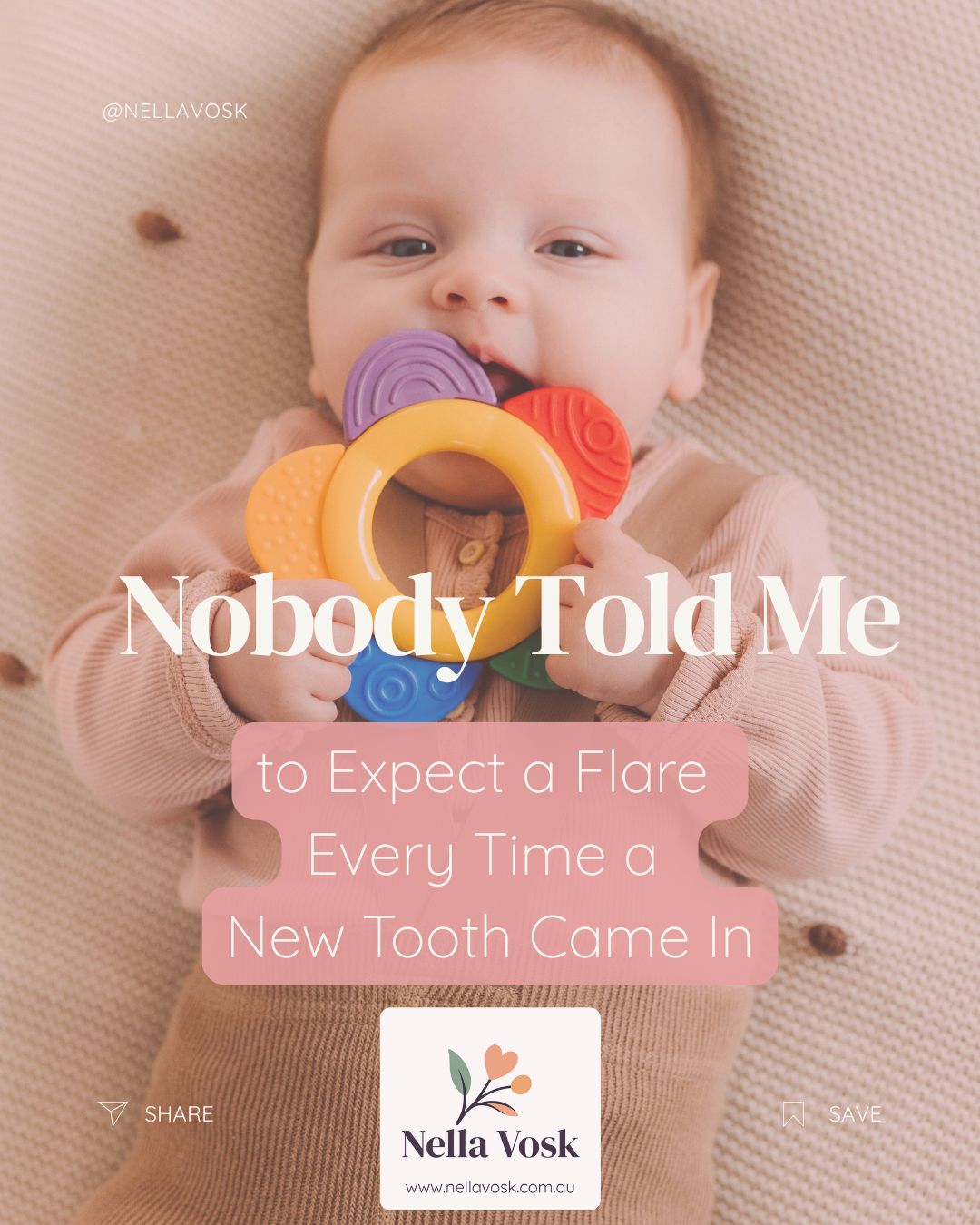
  • Nobody Told Me to Expect a Flare Every Time a New Tooth Came In

    Founder of Nella Vosk • 14+ years supporting families across motherhood, feeding, and early childhood wellbeing

    Nobody Told Me to Expect a Flare Every Time a New Tooth Came In

    triggers, skin barrier care, and protecting your child's skin through every phase.

    This article is part of Nella Vosk's Nobody Told Me series — a growing collection of posts written for the parent who has been trying everything and still feels like they're failing their child. Every post in this series starts from a moment a parent wasn't given information they needed, and works back through what the evidence actually says. You can find the full series at nellavosk.com.au/pages/nobody-told-me.

    Nobody told me to expect a flare every time a new tooth came in.

    I remember the first time it happened. We'd had a relatively calm week — the eczema was manageable, the nights were survivable — and then, out of nowhere, the skin around my daughter's mouth was raw and red, her cheeks were inflamed, and she was up every hour. I spent three days convinced I'd done something wrong. Changed something, missed something, failed something.

    I hadn't. She was teething.

    If someone had told me early on that teething and eczema are closely connected — that flares during teething are not a random failure but a predictable pattern with identifiable causes — I would have managed those weeks very differently. Less panic. More preparation.

    That's what this post is about.

    Why Does Teething Make Eczema Worse?

    Teething doesn't cause eczema — but it reliably triggers flares in children who already have it. There are three main mechanisms, and once you understand them, the pattern makes complete sense.

    1. The drool factor

    A teething baby drools significantly more than usual. Saliva is mildly acidic and contains enzymes that are helpful inside the mouth — but when it sits on skin for extended periods, especially already-compromised eczema-prone skin, it acts as an irritant. The skin around the mouth, chin, cheeks, and neck takes the brunt of this. This is why teething-related eczema flares so often appear exactly where drool pools.

    It's also worth knowing that drool rash and eczema are different conditions — and the two can occur at the same time, which makes the skin look worse than either alone would. Drool rash is a contact irritation; eczema is an immune-mediated inflammatory response. The management approach for each is slightly different, though barrier cream around the mouth helps with both.

    2. The immune system is temporarily occupied

    Teething creates a low-level systemic immune response. The body is managing inflammation in the gums, and for a child with eczema — whose immune system is already calibrated to overreact to skin triggers — this temporary additional immune load can lower the threshold for a flare. It's not dramatic. It's not a crisis. But it means that things that might otherwise be manageable — a slightly warm room, a new washing powder, a missed moisturising session — tip the skin over the edge during a teething period.

    3. Heat and disrupted sleep compound everything

    Teething is often accompanied by mild fever or elevated body temperature — and heat is one of the most consistent eczema triggers. A baby who is running warm, sweating slightly at night, and sleeping poorly will have more eczema activity. The itch-scratch cycle that's hard enough to interrupt when everyone is calm becomes nearly impossible to manage when the child is also in pain from teething and waking frequently.

    What Actually Helps During a Teething Flare

    The good news is that teething flares are temporary. Teeth come through, the immune load settles, the drool reduces, and the skin — if you've protected it as well as possible in the meantime — can recover.

    In the short term, a few things make a real difference:

    Barrier protection around the mouth. Apply a thick, fragrance-free balm or barrier ointment (plain petroleum jelly works well) around your baby's mouth, chin, and cheeks before sleep and throughout the day. This creates a physical buffer between the drool and the skin. Reapply frequently — every nappy change is a useful prompt.

    Gentle, frequent patting — not wiping. When you remove drool from the skin, pat with a soft, damp cloth rather than wiping. Wiping repeatedly on already-irritated skin causes mechanical damage to the skin barrier. Pat, then reapply barrier cream immediately.

    Scratch protection, especially at night. A teething baby who is already prone to scratching will scratch more when their skin is inflamed and their sleep is disturbed. Eczema mitten sleeves are more reliable than scratch mittens during teething periods because they stay on — important when you're dealing with a baby who is waking and moving more than usual.

    Breathable sleepwear. Because elevated body temperature is part of what's driving the flare, keeping the skin cool overnight matters. Natural fibres like bamboo regulate temperature more effectively than cotton-polyester blends, and cooler skin means less itching. Our guide to dressing a baby with eczema for bedtime covers this in detail.

    Maintain your moisturising routine. When the skin is flaring and nights are disrupted, it's easy to let the routine slip. Try not to. Consistent emollient application — at least twice daily, immediately after bathing — is the most important thing you can do to support the skin barrier through a teething period. Skipping it even for a few days prolongs the recovery.

    For the Full Picture: Our Detailed Teething and Eczema Guide

    If you're in the middle of a teething flare right now and need more comprehensive guidance — including information on the drool rash vs eczema distinction, how to manage fever-related flares, and practical approaches to the specific skin locations teething most commonly affects — we've covered it in depth in our detailed article: Eczema and Teething: Taking a Deeper Look.

    The short version: you didn't cause the flare. You didn't miss something. Your child's skin is responding to a predictable biological process — and now that you understand why, you can prepare for the next tooth before it arrives.

    Related Reading

    Eczema and Teething: Taking a Deeper Look — the full clinical guide to managing eczema through teething periods

    Sweat and Eczema: Why Heat Triggers Flares — why elevated temperature during teething makes the flare worse

    How to Dress a Baby with Eczema for Bedtime — breathable sleepwear during teething flares

    Eczema Mittens vs Sleeves: Which Is Better? — why mitten sleeves outperform scratch mittens during disrupted nights

    Infected Eczema in Babies: Signs, Symptoms & When to Act — because teething flares with broken skin carry infection risk

    Written by Kelly Northey, CPPNP — Certified Postpartum and Perinatal Nutrition Professional, and founder of Nella Vosk. Kelly has supported Australian families navigating eczema through the Bamboo Bubby range for over 15 years.
    She writes the Nobody Told Me series because the information gap costs families too much — in sleep, in guilt, and in skin.


    Also in Nobody Told Me: Your Baby's Skin

    Nobody Told Me I Had to Fight That Hard Just to See a Dermatologist
    Nobody Told Me I Had to Fight That Hard Just to See a Dermatologist

    Read More
    Nobody Told Me That the Antibiotics for the Infected Eczema Might Make the Next Infection More Likely
    Nobody Told Me That the Antibiotics for the Infected Eczema Might Make the Next Infection More Likely

    Read More
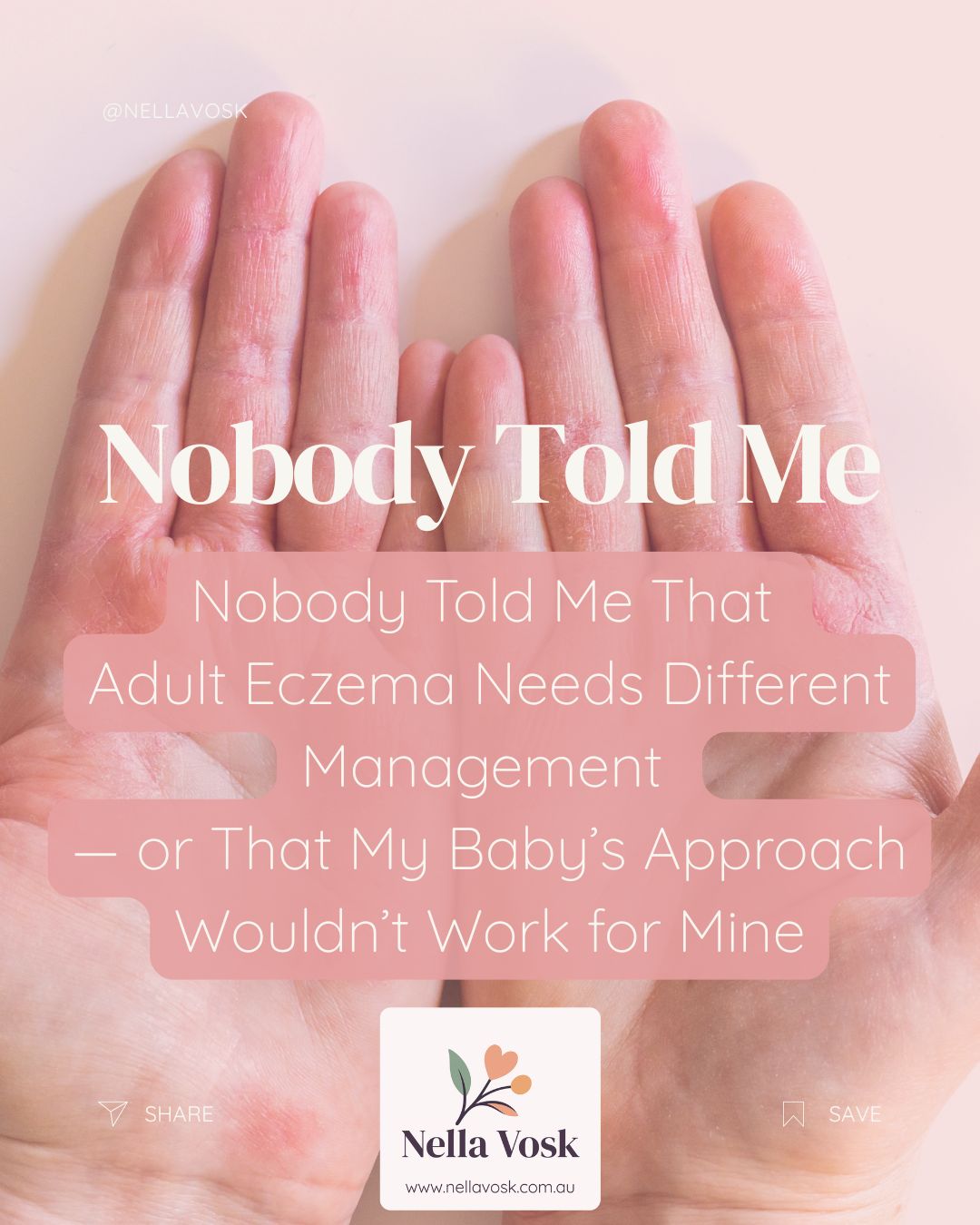
    Nobody Told Me That Adult Eczema Needs Different Management — or That My Baby’s Approach Wouldn’t Work for Mine
    Nobody Told Me That Adult Eczema Needs Different Management — or That My Baby’s Approach Wouldn’t Work for Mine

    Read More