
• Add description, images, menus and links to your mega menu

  • A column with no settings can be used as a spacer

  • Link to your collections, sales and even external links

  • Add up to five columns

  • da

  • A column with no settings can be used as a spacer

  • Link to your collections, sales and even external links

  • Add up to five columns

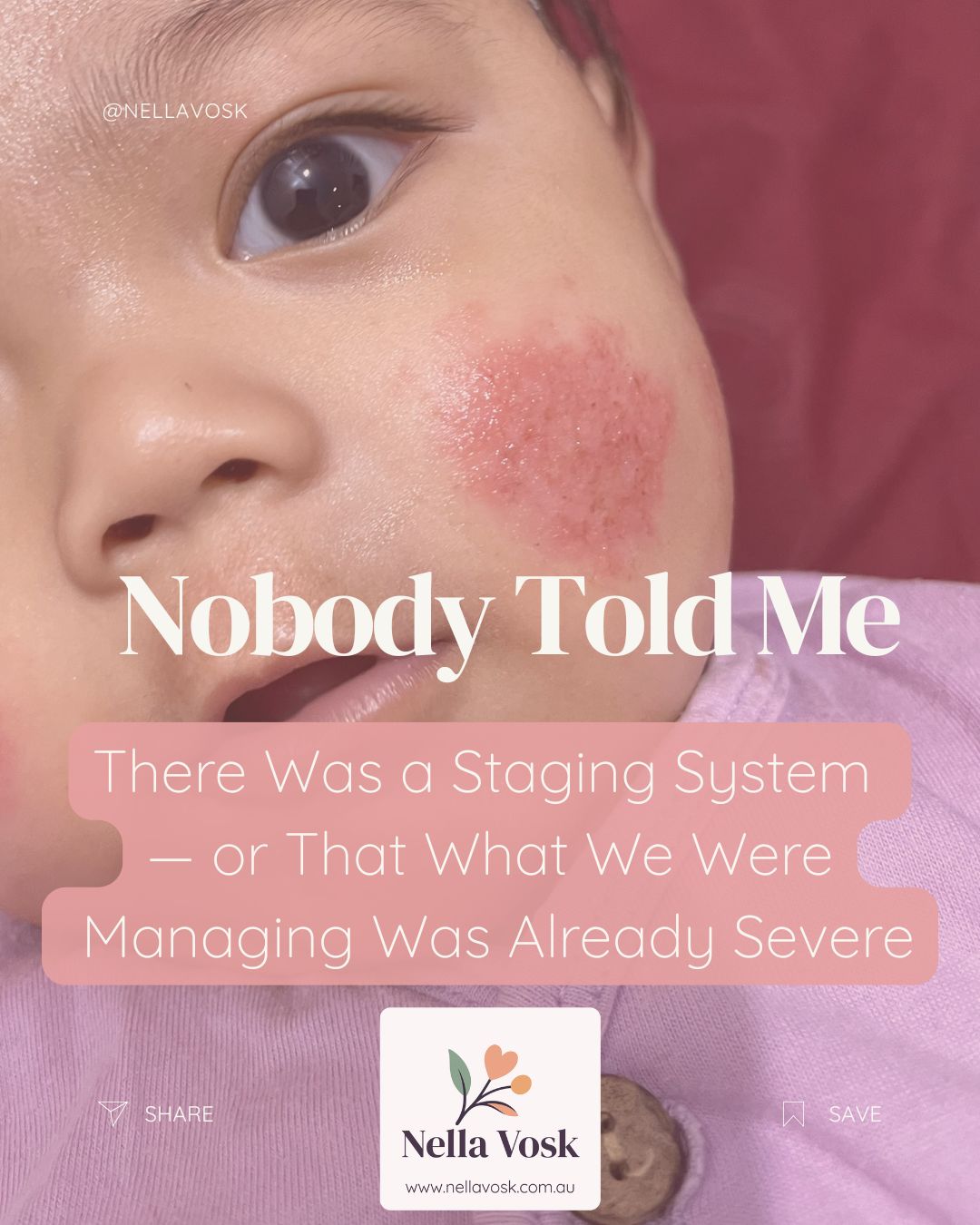
  • Nobody Told Me There Was a Staging System — or That What We Were Managing Was Already Severe

    Founder of Nella Vosk • 14+ years supporting families across motherhood, feeding, and early childhood wellbeing

    Nobody Told Me There Was a Staging System — or That What We Were Managing Was Already Severe

    This article is part of the Nella Vosk Complete Guide to Baby Eczema for Australian Families — everything parents managing atopic dermatitis need to know about triggers, management, and the skin barrier.

    This article is part of Nella Vosk’s Nobody Told Me series — a growing collection of posts written for the parent who has been trying everything and still feels like they’re failing their child. Every post in this series starts from a moment a parent wasn’t given information they needed, and works back through what the evidence actually says. You can find the full series at nellavosk.com.au/pages/nobody-told-me.


    Nobody told me there was a staging system — or that what we were managing was already severe.

    I spent nearly eighteen months thinking my son’s eczema was ‘just bad’. Bad in a vague, un-gradable way. Bad in the way that meant I kept trying different things without a clear sense of what the bar was — what ‘better’ looked like, what level of flare warranted what kind of intervention, when I was supposed to go back to the GP versus manage at home. Nobody had explained the system to me.

    There is a system. Eczema has formally recognised severity classifications — mild, moderate, and severe — with specific criteria for each, and those classifications directly inform which treatments are appropriate. The reason it matters is not academic. A child with mild eczema managed with regular emollient and occasional low-potency topical steroid is appropriately managed. A child with severe eczema managed with the same approach is under-managed, and the gap between the two has real consequences for the child’s sleep, behaviour, skin health, and long-term allergy risk.

    If nobody has ever told you which stage your child’s eczema is at, this post is for you.

    The Three Severity Stages

    The classification most commonly used in Australian clinical practice draws on validated scoring tools — particularly SCORAD (SCORing Atopic Dermatitis) and EASI (Eczema Area and Severity Index) — but in practical terms, severity is assessed across three dimensions: how much of the body surface is affected, how severe the visible signs are (redness, weeping, thickening, crusting), and how significantly the itch is affecting the child’s daily life and sleep.

    Mild eczema: affects a small area of the body surface (generally less than 10%), causes intermittent itch that is manageable and doesn’t significantly disrupt sleep, and the visible signs — dryness, redness — are present but not severe. In mild eczema, consistent twice-daily emollient application and trigger avoidance are often sufficient to maintain control. Short courses of low-potency topical corticosteroid are used during flares. Most babies who develop eczema start here.

    Moderate eczema: covers a larger body surface area (roughly 10–30%), causes frequent itch that disrupts sleep regularly, and the visible signs are more pronounced — redder, more widespread, with areas of thickening or lichenification developing in chronic sites. Moderate eczema requires more consistent use of topical corticosteroids during flares, may need a step up in potency, and often benefits from a more structured management plan. This is the stage at which the itch-scratch-infection cycle becomes a significant management challenge.

    Severe eczema: affects a large proportion of the body surface (more than 30%), causes near-constant itch and significant sleep disruption most nights, and the skin shows extensive changes — widespread redness, persistent weeping, thick lichenified patches, and frequent secondary infection. Severe eczema in a baby or child warrants specialist assessment. Standard GP-level management with emollient and mild-to-moderate topical steroids is often insufficient at this stage, and families managing severe eczema without specialist input are frequently under-resourced.

    Why Parents Often Don’t Know Which Stage They’re At

    There are a few reasons the staging conversation doesn’t happen reliably at GP appointments. Eczema consultations are often short. The GP is frequently focused on immediate intervention — prescribing a steroid cream, assessing for infection — rather than stepping back to classify severity and explain the treatment ladder that follows from it. And eczema fluctuates: the skin that looks moderate at a GP appointment may look severe the following week during a flare, which makes a snapshot assessment feel less useful than it is.

    The other factor is that severity language in eczema has a specific clinical meaning that doesn’t always match the colloquial one. A parent managing a child whose eczema is disrupting sleep every night, covering large areas of the body, and requiring frequent trips to the GP may not have been told their child’s eczema is clinically severe — but by the criteria above, it is. And that classification matters for knowing what level of treatment is appropriate and when to push for specialist referral.

    What Does Mild Baby Eczema Look Like?

    In mild eczema, the skin is dry and may look slightly red or pink in patches — commonly on the cheeks, behind the ears, in the elbow creases, and behind the knees. The patches are not weeping or crusting. The baby may scratch occasionally, particularly in the evening or after bathing, but is not visibly distressed by itching for extended periods and is sleeping reasonably well. A mild flare typically settles within a few days of consistent emollient application and trigger avoidance.

    What mild eczema does not look like: raw, weeping skin; honey-coloured crusting (a sign of infection); skin that is visibly thickened or leathery; scratching that prevents the baby from settling to sleep; or patches that are not improving with regular emollient use.

    The Treatment Ladder: Why Staging Matters

    Australian dermatology guidelines follow a stepped approach to eczema treatment, where the interventions used are matched to severity. Understanding where your child sits on the staging system helps you understand which interventions are appropriate at each level.

    At the mild level: consistent fragrance-free emollient applied twice daily (minimum), with a low-potency topical corticosteroid (such as 1% hydrocortisone) used for short courses during flares. Trigger identification and avoidance. Fragrance-free laundry and bath products.

    At the moderate level: all of the above, with a moderate-potency topical corticosteroid for flares, applied to affected areas as directed. Attention to the application sequence (steroid first, then emollient) matters at this level — we covered the evidence on this in 

    At the moderate level (continued): structured follow-up with a GP to assess whether the current approach is working. If moderate eczema is not responding to consistent management, a step up is warranted rather than continuing the same approach indefinitely. NTM-2-04: Nobody Told Me the Order You Apply Skincare Matters.

    At the severe level: specialist referral (paediatric dermatologist) is appropriate. Treatments available at the specialist level include higher-potency topical corticosteroids used under supervision, topical calcineurin inhibitors (tacrolimus, pimecrolimus), and — for the most severe and refractory cases — newer biological therapies. Wet wrapping is a technique commonly used in severe flare management and is more effective when guided by a clinician familiar with the child’s history.

    The Sleep Connection

    One of the most useful signals that eczema has crossed from mild to moderate or severe is sleep disruption. A baby or child with well-controlled mild eczema will have occasional bad nights, but not consistent nightly waking from itch. When sleep is disrupted most nights — when the parent is up multiple times because of scratching, when the baby is waking distressed, when the morning reveals skin damage from overnight scratching — that pattern is a clinical indicator of at least moderate eczema. How to stop baby scratching at night covers the practical side of nighttime management in detail, including scratch protection and temperature management.

    The relationship also runs the other way: sleep deprivation in the child worsens stress hormone regulation, which worsens itch, which worsens sleep further. Getting the staging right and the treatment matched to it is one of the most direct paths to breaking that cycle.

    When to Advocate for a Step Up

    If your child’s eczema is disrupting sleep most nights, covering significant areas of the body, requiring frequent visits to the GP, leading to recurrent infections, or simply not improving despite consistent management — those are all signals that the current treatment level may not be matched to the severity. It is entirely appropriate to say at a GP appointment: “I’d like to understand where my child’s eczema sits on the severity scale, and whether the current management is appropriate for that level.”

    If the answer is that the eczema is moderate to severe and the current management is standard GP-level care, it is equally appropriate to ask about referral to a paediatric dermatologist. The staging system exists precisely to make that conversation easier to have.

    Related Reading

    Wet Wrapping for Eczema: How It Works, When to Use It

    Infected Eczema in Babies: Signs, Symptoms & When to Act

    How to Stop Baby Scratching at Night

    NTM-2-12: Nobody Told Me the Cream I Was Using Could Be Triggering the Eczema

    NTM-2-04: Nobody Told Me the Order You Apply Skincare Matters with Eczema


    ABOUT THE AUTHOR
    Kelly Northey is a Certified Postpartum Nutrition Professional (CPPNP) and founder of Nella Vosk, the parent company of the Bamboo Bubby range. She has spent fourteen years working with Australian families navigating baby and child eczema — the sleepless nights, the skin that won’t heal, and the guilt of feeling like you should be doing more. The Bamboo Bubby range exists because of those families.
    Learn more about Kelly.


    Also in Nobody Told Me: Your Baby's Skin

    Nobody Told Me I Had to Fight That Hard Just to See a Dermatologist
    Nobody Told Me I Had to Fight That Hard Just to See a Dermatologist

    Read More
    Nobody Told Me That the Antibiotics for the Infected Eczema Might Make the Next Infection More Likely
    Nobody Told Me That the Antibiotics for the Infected Eczema Might Make the Next Infection More Likely

    Read More
    Nobody Told Me That Adult Eczema Needs Different Management — or That My Baby’s Approach Wouldn’t Work for Mine
    Nobody Told Me That Adult Eczema Needs Different Management — or That My Baby’s Approach Wouldn’t Work for Mine

    Read More